A rights inquiry links poor newsroom wages to ethics, media survival and democratic accountability.
By Collins Mtika
Malawi is often presented internationally as a multiparty democracy with a vibrant media industry and constitutional protections for press freedom.
But a new investigation by the Malawi Human Rights Commission (MHRC) raises a more fundamental question: can journalists hold power to account when many struggle to meet their own basic needs?
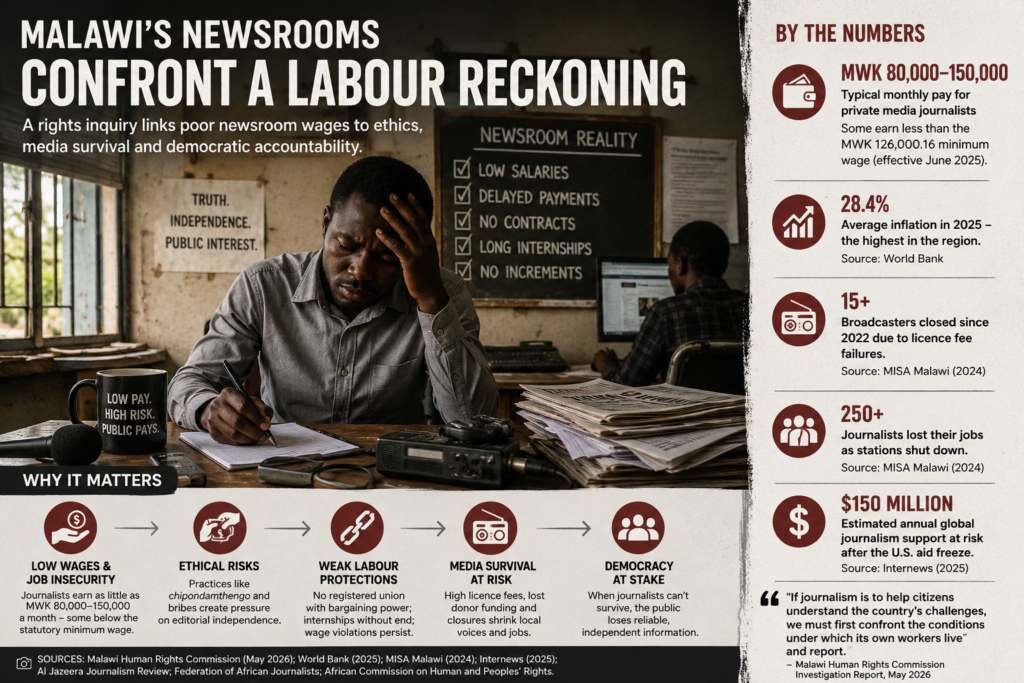
The commission’s May 2026 report found that journalists in Malawi’s private media sector commonly earn between MWK 80,000 and MWK 150,000 a month, with some receiving less than the statutory minimum wage of MWK 126,000.16 introduced in June 2025.
The findings suggest that Malawi’s media freedom challenges are not only political or legal but increasingly economic.
Low pay, irregular salaries and weak labour protections, the report argues, create incentives for ethical compromise, undermine collective bargaining and threaten access to reliable information, particularly in rural areas.
The investigation, conducted between April 2025 and January 2026 after a complaint by media scholar Davie Danford Mchinga of Fayetteville State University, comes as Malawi faces broader economic strain.
According to the World Bank, inflation averaged 28.4% in 2025, the highest in the region, while currency depreciation and fiscal pressures eroded household incomes and business confidence.
The media sector has also been affected by the global contraction in donor support. Following the United States aid freeze in 2025, Internews estimated that roughly $150 million in annual journalism and media assistance would largely disappear worldwide.
Together, these pressures have intensified financial stress across private and community media outlets.
The World Bank says firms face high borrowing costs, foreign-exchange shortages and weak consumer demand, conditions that reduce advertising revenues while increasing operating expenses.
The MHRC report says some media houses borrow money to pay wages, delay salaries or go six to seven years without salary adjustments.
Some journalists reportedly receive partial payments of MWK 30,000 during salary delays, while correspondents may earn as little as MWK 1,000 for a published or broadcast story and often work without formal contracts.
The commission also documents cases of prolonged internships, with some interns remaining in newsrooms for years without permanent employment.
Such conditions, the report argues, have implications beyond workers’ welfare. Journalists who must finance transport and communications before earning modest fees face financial pressures that can affect editorial independence and professional standards.
One example is chipondamthengo, an informal cash payment from sources or event organisers to journalists for covering events.
The MHRC says low-paid journalists increasingly depend on such payments as a survival strategy, even though Malawi’s media ethics codes prohibit practices that compromise independence.
The practice has long attracted scrutiny. The Al Jazeera Journalism Review has described chipondamthengo as raising concerns about corruption risks, media independence and public trust.
The commission also records allegations that some journalists accept payments from politicians to promote favourable coverage, suppress negative stories or advance political interests, including through pseudonymous social media accounts.
These allegations remain findings contained in the report and are not independently verified case records.
The labour concerns exist alongside constitutional protections. Malawi guarantees both press freedom and the right to fair labour practices, including fair remuneration and the freedom to join trade unions.
But the MHRC argues that institutional safeguards remain fragmented.
The Journalists Union of Malawi is reportedly not registered with the Malawi Congress of Trade Unions and is not formally recognised by the Ministry of Labour, limiting its bargaining power.
The ministry instead recognises the Communication Workers Union of Malawi.
Labour enforcement has produced mixed results. According to the report, the Ministry of Labour conducted more than 2,000 inspections in 2025 and identified violations including unpaid wages and uncompensated overtime, particularly at community radio stations.
The Media Council of Malawi acknowledged concerns about journalists’ welfare and weak enforcement.
The MHRC further alleges that some private media houses discourage union membership and restrict opportunities for further studies, leaving journalists with limited avenues to negotiate conditions or challenge retaliation.
Economic pressures extend to broadcasting regulation.
The Malawi Communications Regulatory Authority licenses broadcasters, while MISA Malawi says annual content licence fees are denominated in US dollars: $100 for community radio stations, $1,500 for regional broadcasters and $5,000 for national broadcasters, including television stations.
MISA reported in 2024 that more than 15 broadcasters had closed since 2022, resulting in the loss of more than 250 journalism jobs after licence-renewal failures. A regional MISA statement said some stations took bank loans, delayed salaries or relied on church contributions to remain operational.
The implications extend beyond media businesses. Radio remains Malawi’s most widely accessible medium, particularly in rural areas, where community stations provide local-language information and public-interest programming.
The African Commission on Human and Peoples’ Rights has described broadcasting as especially important across Africa because of its ability to reach large audiences at relatively low cost and overcome literacy barriers.
Malawi’s experience reflects broader trends across the continent. The Federation of African Journalists says many journalists face low wages, job insecurity and inadequate resources.
Similar concerns have been documented in Zambia and Uganda, where studies have reported low earnings among journalists in private and community media.
Still, Malawi’s challenges are not solely the result of global economic pressures. Questions about minimum-wage compliance, labour protections and collective bargaining ultimately fall within domestic institutions and policy choices.
The dilemma is difficult.
Stricter enforcement of labour standards could place additional strain on financially fragile outlets. But failing to address poor conditions risks entrenching underpaid journalism and weakening public trust.
For the MHRC, the issue is not simply whether media organisations can survive economically. It is whether journalists can continue serving the public interest while many remain trapped in the same economic hardships they are expected to scrutinise.
If journalism is to help Malawians understand the country’s economic and political challenges, the report suggests, the industry may first need to confront the conditions under which its own workers live and report.
