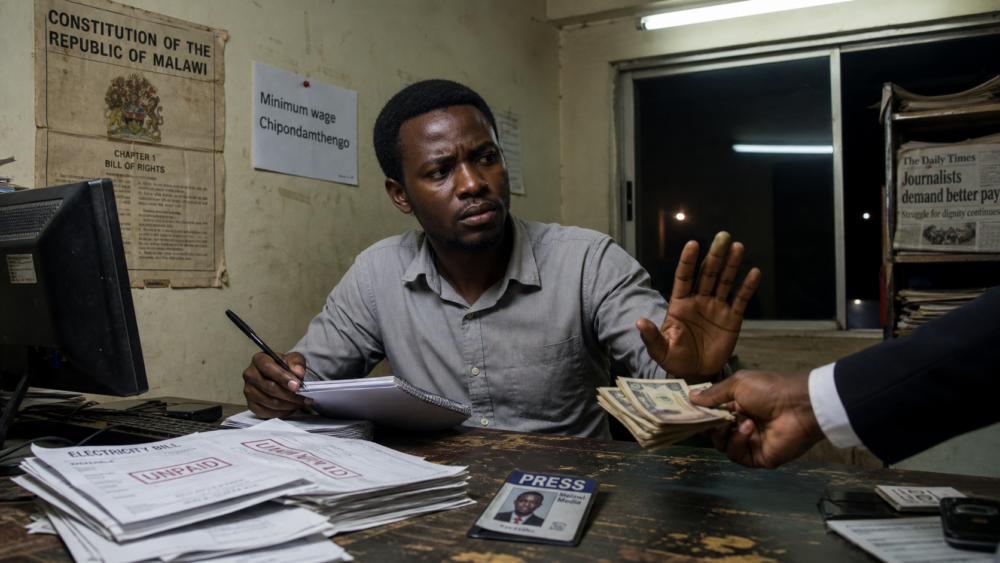
A human rights investigation found Malawi’s private media journalists underpaid, vulnerable to conflicts of interest, and poorly protected.
By Collins Mtika
Malawi’s private media houses are paying some journalists below the legal minimum wage, exposing them to financial pressures that undermine professional independence and weaken the public’s right to reliable information.
That is the central finding of a nine-month investigation by the Malawi Human Rights Commission, released in May 2026, which gathered evidence from journalists, media organisations, government ministries and regulatory institutions across the country.
The Commission found that some private media employers openly pay journalists less than Malawi’s statutory minimum wage, while institutions responsible for protecting labour rights have struggled to enforce existing laws and standards.
The consequences extend beyond employment conditions. The investigation argues that persistent underpayment, weak labour protections and inadequate oversight are creating conditions that threaten the integrity of journalism itself.
This is not simply a labour dispute. It is a question of whether journalists can perform their public watchdog role while struggling to meet their own basic needs.
The journalists at the centre of the crisis
The investigation focused on junior journalists in private media houses, including entry-level and mid-level reporters.
These journalists carry out much of the daily work of reporting. They gather information, interview sources, write stories and produce content under tight deadlines. In many countries, they form the backbone of the newsroom.
In Malawi, however, the Commission found that many earn between MWK80,000 and MWK150,000 a month, while some receive considerably less.
One journalist told investigators he had received as little as MWK30,000 in a particular month to cover living expenses while waiting for delayed salary payments.
The statutory minimum wage for general workers in Malawi, introduced in June 2025, stands at MWK126,000 per month.
The Commission found that some journalists therefore earn less than the legal minimum wage, placing media employers in potential breach of labour laws and constitutional protections guaranteeing fair remuneration.
The investigation also found that some media organisations had gone years without increasing salaries, while others lacked formal salary structures altogether.
As a result, journalists with similar qualifications and responsibilities could receive markedly different pay without transparent justification.
The rise of the “chipondamthengo” economy
For many journalists, low wages have encouraged reliance on informal payments commonly known as chipondamthengo. The term refers to cash given by event organisers, institutions or public officials to journalists covering their events.
What may once have been regarded as a token of appreciation has, according to the Commission, evolved into an informal income stream that many journalists depend on to supplement inadequate salaries.
Investigators found that some journalists attended events without invitations in the expectation of receiving such payments.
The Media Council of Malawi’s code of ethics prohibits journalists from accepting money or gifts from news sources. However, the Commission concluded that enforcement of these standards has been weak and that economic hardship has made compliance increasingly difficult.
The implications extend beyond ethics.
A journalist covering a government ministry event may also depend on that institution for transport or meal allowances. The Commission argues that such financial dependence risks compromising editorial independence and public confidence in news coverage.
Poverty and vulnerability to influence
The Commission also documented allegations that some journalists had accepted payments from politicians or other influential figures in exchange for favourable coverage or the suppression of unfavourable stories.
One journalist told investigators that a politician had approached him to stop publication of a story. According to the journalist’s account, he refused but alleged that the politician subsequently persuaded an editor to withhold the report.
The Commission does not suggest that corruption is widespread among all journalists. On the contrary, it notes that many interviewees spoke candidly about the ethical pressures they face and expressed discomfort with practices that compromise professional standards.
Its concern is structural.
The investigation argues that persistent underpayment and insecure employment create conditions in which conflicts of interest become more likely, weakening the independence that journalism requires to serve the public effectively.
This has implications for constitutional rights.
Section 37 of Malawi’s Constitution guarantees citizens access to information held by the state. That right depends heavily on journalists being able to gather and publish information without undue influence, intimidation or financial dependence.
When journalists cannot afford to remain independent, the Commission argues, the public’s right to information may be weakened even if newspapers continue to publish and radio stations remain on air.
Limited labour protections
The investigation also examined the state of labour representation within Malawi’s media industry.
The Journalists Union of Malawi, known as JUMA, was established to advance journalists’ labour rights. However, the Commission found that the union had not been registered with the Malawi Congress of Trade Unions, the country’s main federation of labour organisations.
The Ministry of Labour told investigators it did not formally recognise JUMA.
Without registration and legal standing, the Commission noted, the union cannot effectively negotiate collective agreements or formally represent journalists in labour disputes.
Journalists interviewed during the investigation also reported fearing retaliation from employers for participating in union activities.
The result, according to the Commission, is that collective bargaining remains largely inaccessible to journalists working in private media.
Economic pressures on media organisations
The investigation also highlights broader economic pressures affecting Malawi’s media industry.
The Malawi Communications Regulatory Authority, or MACRA, charges broadcasting and communications licence fees denominated in United States dollars.
Because most media organisations earn revenue in Malawian kwacha, the Commission argues that exchange-rate fluctuations and foreign currency obligations place additional strain on already fragile business models.
According to the investigation, some media houses have shut down after failing to renew their licences, while others have reduced staffing or frozen recruitment.
Community radio stations, which provide news and information to many rural communities, have been particularly affected.
The Commission also notes that several community media projects supported by the United States Agency for International Development, USAID, have been disrupted following the suspension of funding programmes, leaving some journalists unemployed or working without regular salaries.
Human rights concerns and unanswered questions
The Malawi Human Rights Commission frames these findings as potential violations of constitutional rights.
It cites Section 31(1) of the Constitution, which guarantees fair labour practices, safe working conditions and fair remuneration.
The Commission found evidence that some journalists are paid below the legal minimum wage, while others work without contracts or face dismissal without adequate notice.
It has issued a series of recommendations.
JUMA should register with the Malawi Congress of Trade Unions within two months. Private media houses should raise salaries to comply with the legal minimum wage within three months. MACRA should consider shifting licence fees into local currency within five months, and the Ministry of Labour should conduct targeted inspections of media employers.
Whether these recommendations are implemented remains uncertain.
The Commission has pledged to monitor compliance, but enforcing reforms in an industry where workers fear retaliation and longstanding practices have become entrenched may prove difficult.
The investigation ultimately raises a broader question about accountability.
If journalists charged with exposing abuses of power cannot fully exercise their own labour rights without risking their livelihoods, the institutions that depend on independent journalism may face challenges of their own.
