
Prosecutors withdrew proceedings in two high-profile matters after accused figures returned to powerful posts, raising questions about judicial independence and accountability.
Within months of appointing officials facing serious financial-crime charges to senior posts, Malawi’s government has discontinued two of the country’s largest ongoing prosecutions, a move critics say tests the rule of law as the new administration seeks to rebuild credibility with the International Monetary Fund (IMF) and international donors.
Across sub-Saharan Africa, incoming governments face a recurring dilemma: what to do with corruption cases launched under previous administrations against figures who later return to influence.
In Kenya, South Africa and Nigeria, the abandonment or revival of high-profile cases has become a proxy measure of institutional independence.
Malawi, one of the world’s poorest and most aid-dependent countries, now offers a fresh case study.
In February 2026, the Director of Public Prosecutions (DPP) withdrew criminal proceedings in two major financial-crime matters involving senior public officials. Among the accused are serving cabinet ministers and newly appointed senior government figures.
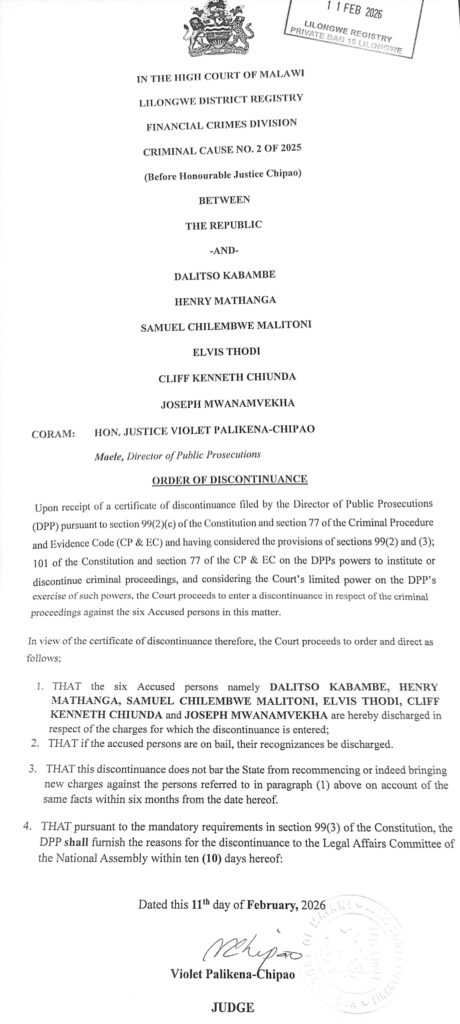
The first case, Republic v. Dalitso Kabambe and Others, centred on the handling of public funds linked to the COVID-19 response and a $350 million facility the Reserve Bank of Malawi (RBM) obtained from the African Export-Import Bank (Afreximbank).
Prosecutors alleged that the facility was used without parliamentary approval and was not properly disclosed to the IMF. The indictment also included allegations around a K14.79 billion payment to FDH Bank that the state described as unlawful.
Defendants included former RBM Governor Dalitso Kabambe, his deputy Henry Mathanga, former Secretary to the Treasury Cliff Chiunda, and others.
Prosecutors argued that the manner in which the facility was contracted and reported breached public finance and governance rules, with broader implications for Malawi’s programme compliance and external financing.
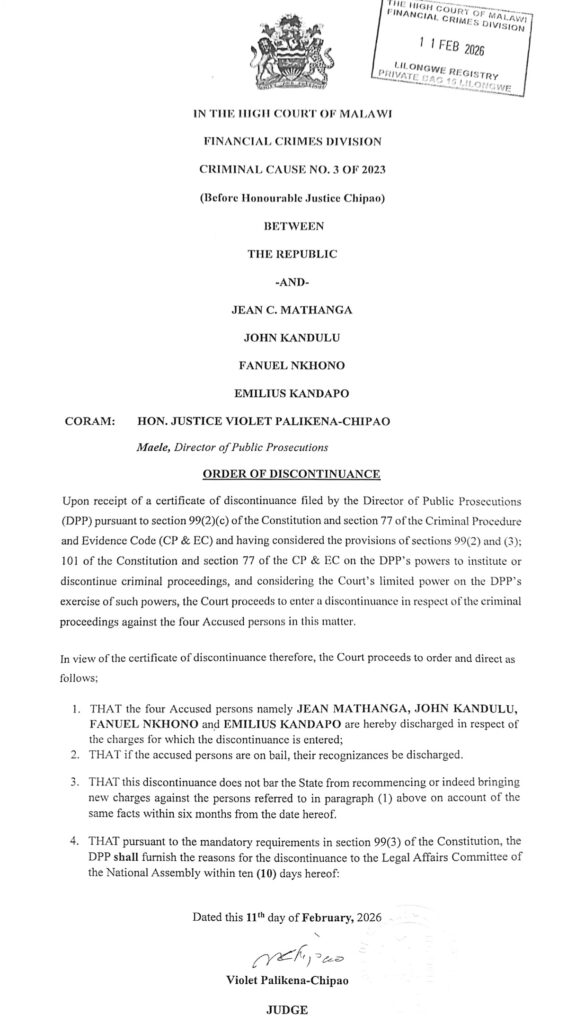
The second case, Republic v. Jean Mathanga and Others, concerned procurement transactions at the Electricity Supply Corporation of Malawi (ESCOM), the national power utility. The Anti-Corruption Bureau (ACB) began investigations in 2017.
The defendants, including former ESCOM board chair Jean Mathanga, former chief executive John Kandulu, and two procurement officials, faced allegations of flouting public procurement procedures in transactions valued at K4.6 billion. By April 2025, 11 state witnesses had testified, according to the case record.
The timing of the withdrawals has become central to the controversy.
President Peter Mutharika, 85, returned to office after winning the September 2025 election with 56.8% of the vote, defeating incumbent Lazarus Chakwera.
The discontinued prosecutions largely concerned officials who served during Mutharika’s previous administration from 2014 to 2020, several of whom have since been elevated to influential roles.
In October 2025, Cliff Chiunda was appointed Secretary to the Treasury. On 1 January 2026, Henry Mathanga was reinstated as RBM deputy governor through a consent order brokered by the Attorney General’s office, despite previous disciplinary proceedings and pending criminal charges.
Joseph Mwanamvekha became Minister of Finance. Jean Mathanga became Minister of Energy and Mining. Days later, the prosecutions were discontinued.
On 4 February 2026, High Court Judge Redson Kapindu confirmed the discontinuance of the Kabambe matter.
On 11 February, Judge Violet Palikena Chipao entered a discontinuance order in the ESCOM case. Court documents indicate the DPP acted on the direct instruction of the Attorney General.
Under Section 99 of Malawi’s Constitution, the DPP has authority to discontinue any criminal proceedings before judgement. The same provision requires reasons to be furnished to Parliament’s Legal Affairs Committee within 10 days.
A spokesperson for the Ministry of Justice, Frank Namangale, confirmed that the DPP would account to the committee but did not disclose the grounds for discontinuance.
The withdrawals come as Malawi’s fiscal position remains precarious and the government seeks to re-engage the IMF.
An IMF Extended Credit Facility (ECF) approved in November 2023 totalled $175 million but was terminated in May 2025 after 18 months without a completed review. Only $35 million was disbursed under the arrangement.
In its most recent consultation, the Fund recorded weak growth, high inflation and strained public finances, while urging authorities to strengthen governance and “advance the fight against corruption.”
A key IMF benchmark has been the publication of a Governance Diagnostic Assessment examining procurement, state enterprises and anti-corruption enforcement.
The report has not been made public. Transparency International’s 2024 index ranked Malawi 107th out of 180 countries, with a score of 34 out of 100.
For critics, the discontinuances remove a major legal obstacle for newly appointed officials.
They also send a signal at a moment when the administration needs to reassure donors and negotiate a successor IMF programme where governance conditions are likely to feature prominently.
The controversy also revives a longstanding structural concern: the scope of the DPP’s discretion and the weakness of oversight. While Section 99 requires post-hoc accountability to a parliamentary committee, it does not require prior judicial review.
The Malawi Law Society has called for reform, arguing that prosecutorial discontinuances should be reviewable by courts.
The vulnerability is not new and not uniquely partisan. Under the previous Chakwera administration, the DPP discontinued multiple high-profile matters, including one involving then Vice-President Saulos Chilima, prompting the ACB to say it had been ready to proceed.
Economist Bertha Bangara-Chikadza of the University of Malawi, who chairs the Economists Association of Malawi, has repeatedly warned that selective anti-corruption enforcement can carry immediate economic consequences, including reduced aid flows and weaker access to international financing frameworks.
The Afreximbank facility sits at the intersection of sovereign borrowing, central bank governance and external oversight. Afreximbank’s exposure to Malawi has been reported at roughly $800 million.
If courts cannot test how such facilities are contracted and disclosed, critics argue, the credibility risk extends beyond Malawi to lenders and oversight institutions that monitor programme compliance.
What happens next will depend on political pressure and institutional response.
One scenario is that Parliament’s Legal Affairs Committee accepts the DPP’s explanation, the withdrawals stand, and the cases are effectively closed.
A second is that sustained scrutiny from Parliament, civil society, or donors forces renewed action through mechanisms available to prosecutors under Malawi’s legal framework.
A third, viewed by governance advocates as the most consequential, would be publication of the Governance Diagnostic Assessment and reforms that strengthen prosecutorial independence within a new IMF programme, including possible legislative changes affecting the DPP’s discontinuance power.
For Malawi, the question is not only legal.
It is whether governance commitments made in the pursuit of international financing will endure once political power shifts and whether institutions can remain credible when politically connected defendants return to the centre of the state.
