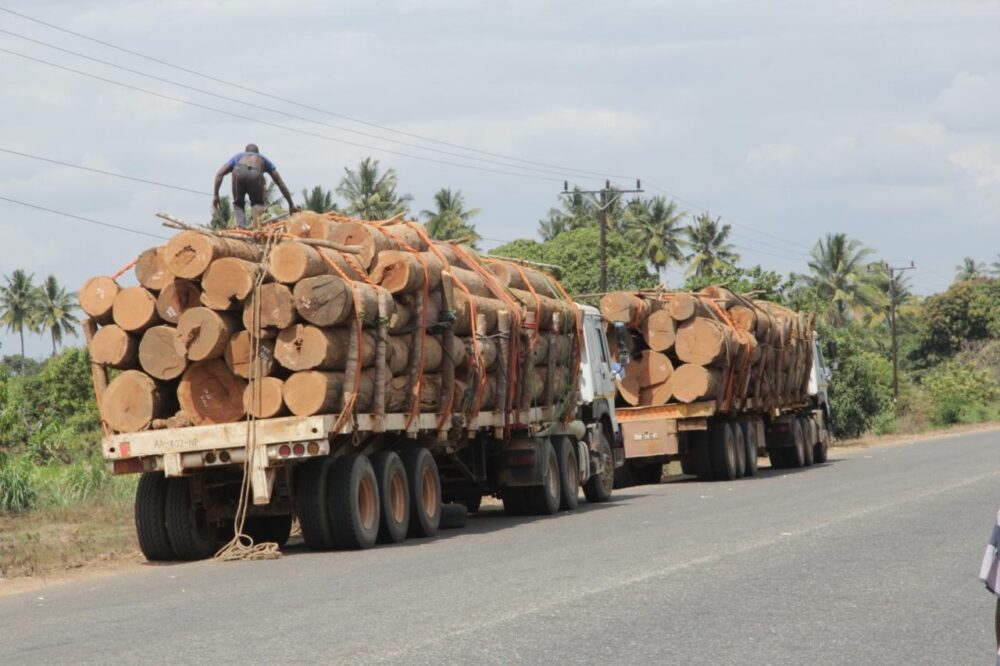
A court ruling in central Mozambique offers a rare, evidence-based test of the country’s timber laws, showing how judicial scrutiny can curb illegal logging while allowing legitimate trade to proceed.
By CIJM
In October 2025, 111 containers of sawn timber sat under detention in central Mozambique, their fate hinging on a question that has long confounded the country’s forest authorities: were they the product of lawful processing, or part of the illicit log trade that has stripped Mozambique’s forests for decades?
A ruling by the Sofala Province Customs Court provided an answer, and signalled a potentially important shift in how Mozambique enforces its timber laws.
After judicial review, the court authorised the release of the containers, owned by Safi Timber Importação e Exportação, Lda., finding that the shipment consisted of legally processed wood rather than prohibited raw logs or protected species.
The containers were cleared to move to the Port of Beira under full documentation and monitoring requirements.
The decision matters not because timber was released, but because of how the law was applied: evidence was tested, safeguards imposed, and the distinction between legal trade and environmental crime was formally upheld.
A sector defined by illegality
Mozambique’s timber sector has long been associated with widespread illegal logging. In 2013, an estimated 93 per cent of logging activity was declared illegal, costing the state roughly US$500 million a year in lost tax revenue.
Weak enforcement, corruption, and sustained foreign demand, particularly for hardwood exports, allowed smuggling networks to flourish while regulatory institutions struggled to respond.
Against that backdrop, the Sofala case illustrates how tighter customs controls combined with judicial oversight can begin to separate lawful commerce from criminal extraction.
In his 31 October order, Judge Carlos Macanja required Safi Timber to post a 3 million meticais security guarantee (approximately US$47,000) before the containers could be released.
The order explicitly allows the amount to be revised if further verification reveals irregularities, maintaining leverage over the exporter even after release.
This approach reflects standard practice in jurisdictions seeking to balance trade facilitation with environmental enforcement: state revenue is protected, forest resources remain safeguarded, and accountability is clearly assigned to exporters, customs officials, and regulators.
How Mozambique’s timber regime works
Since 2017, Mozambique has banned the export of unprocessed logs in an effort to curb deforestation and retain value within the domestic economy.
Semi-processed timber, such as sawn wood, beams, and planks, may be exported under a regulated system that includes export duties, while fully finished wooden products are exempt from export tax.
The policy is designed to encourage domestic processing while slowing the rapid forest loss driven by raw log exports.
The environmental stakes are substantial. Over the past two decades, Mozambique has lost an estimated four million hectares of forest. Much of this loss has been linked to organised smuggling networks exploiting enforcement gaps and sustained overseas demand.
Investigations by the Environmental Investigation Agency (EIA) found that between 2017 and 2023, approximately 89 per cent of Mozambique’s timber exports to China, worth about US$1.3 billion, violated the national log export ban.
The role of the courts
Distinguishing legally sawn timber from prohibited log exports is not a purely administrative exercise. It requires technical inspection, reliable documentation, and judicial independence when disputes arise.
In the Sofala case, the court initially flagged concerns that the shipment might include protected species. Those concerns were examined against inspection reports and documentation and ultimately dismissed following further verification.
That process, scepticism followed by evidence-based determination—is central to effective forest governance.
A recurring legal issue in such cases is compliance with the Convention on International Trade in Endangered Species of Wild Fauna and Flora (CITES).
Several Mozambican hardwoods targeted by smugglers are listed under CITES Appendix II, meaning international trade is permitted only with strict documentation and sustainability assurances.
These species include umbila (Pterocarpus angolensis), chanfuta (Afzelia quanzensis), and pau-preto (African blackwood).
Under Mozambican law, umbila and jambire are classified as first-class timber species and may not be exported in raw form. Yet for years, these species left the country in large volumes.
EIA investigations documented that between 2013 and 2018, more than 2.6 million tonnes of prohibited logs were exported illegally.
As recently as 2023, an estimated 20,000 metric tonnes of protected rosewood were shipped to China despite international restrictions.
By requiring proof that shipments contain processed timber rather than raw logs, courts such as Sofala’s introduce procedural and legal barriers that smuggling networks rely on being absent.
Enforcement beyond the courtroom
The ruling fits within a broader, uneven arc of enforcement reform.
In March 2017, the government launched Operation Tronco, a nationwide crackdown that seized more than 150,000 cubic metres of illegal logs and generated US$1.5 million in fines in a single week in Cabo Delgado province.
Later that year, the establishment of the National Agency for Environmental Quality Control (AQUA) centralised oversight of forest protection.
Results have been mixed but measurable. In 2018, the Gilé National Reserve recorded zero illegal logging cases for the first time in five years, despite dozens of active logging licences around its perimeter.
Nationally, illegal logging continues, but interceptions have increased and the financial risks of non-compliance have risen.
International pressure has reinforced this trend.
In July 2025, representatives of the CITES Scientific Authority warned Mozambique that failure to strengthen enforcement and traceability, particularly for pau-preto, could trigger sanctions, including suspension of all legal timber exports.
The prospect of losing access to global markets has sharpened political attention.
Why legal trade matters
Debate over Mozambique’s timber sector often collapses into a single narrative of environmental crime. The Sofala ruling points to a more differentiated reality.
Legitimate, regulated timber businesses do operate in Mozambique, and they can function lawfully when institutions apply the law consistently.
Safi Timber’s case illustrates the compliance pathway: documented processing, engagement with customs authorities, and recourse to the courts when disputes arise. Other pathways, those built on evasion and bribery, continue to lead to seizure and financial loss.
For forest-dependent communities, the distinction is critical. Illegal logging concentrates profits among smugglers and corrupt officials while degrading ecosystems and generating little public revenue.
Legal timber trade, by contrast, supports domestic processing, employment, and tax collection. Under existing policy, communities are entitled to 20 percent of timber tax revenue, a benefit that materialises only when trade is legal and transparent.
A narrow ruling with broader implications
The Sofala Customs Court decision is procedural rather than dramatic. But it reflects institutional learning: technical evidence was assessed, forestry and customs law applied consistently, financial accountability imposed, and a reasoned order issued.
As Mozambique expands its log export bans to cover all native and plantation species and strengthens verification systems, such precedents will matter.
Each shipment cleared, or stopped, on the basis of sound judicial reasoning builds confidence for compliant businesses and credibility with international partners.
Mozambique’s illegal logging problem remains extensive. But legislative reform, institutional consolidation through AQUA, targeted enforcement, judicial scrutiny, and external pressure are reshaping the terrain.
The Sofala ruling is not a breakthrough on its own. It is one data point in a growing body of forest governance law, one that clarifies where legality ends and criminal extraction begins.
A court ruling in central Mozambique offers a rare, evidence-based test of the country’s timber laws, showing how judicial scrutiny can curb illegal logging while allowing legitimate trade to proceed.
By CIJM
In October 2025, 111 containers of sawn timber sat under detention in central Mozambique, their fate hinging on a question that has long confounded the country’s forest authorities: were they the product of lawful processing, or part of the illicit log trade that has stripped Mozambique’s forests for decades?
A ruling by the Sofala Province Customs Court provided an answer, and signalled a potentially important shift in how Mozambique enforces its timber laws.
After judicial review, the court authorised the release of the containers, owned by Safi Timber Importação e Exportação, Lda., finding that the shipment consisted of legally processed wood rather than prohibited raw logs or protected species.
The containers were cleared to move to the Port of Beira under full documentation and monitoring requirements.
The decision matters not because timber was released, but because of how the law was applied: evidence was tested, safeguards imposed, and the distinction between legal trade and environmental crime was formally upheld.
A sector defined by illegality
Mozambique’s timber sector has long been associated with widespread illegal logging. In 2013, an estimated 93 percent of logging activity was declared illegal, costing the state roughly US$500 million a year in lost tax revenue.
Weak enforcement, corruption, and sustained foreign demand, particularly for hardwood exports, allowed smuggling networks to flourish while regulatory institutions struggled to respond.
Against that backdrop, the Sofala case illustrates how tighter customs controls combined with judicial oversight can begin to separate lawful commerce from criminal extraction.
In his 31 October order, Judge Carlos Macanja required Safi Timber to post a 3 million meticais security guarantee (approximately US$47,000) before the containers could be released.
The order explicitly allows the amount to be revised if further verification reveals irregularities, maintaining leverage over the exporter even after release.
This approach reflects standard practice in jurisdictions seeking to balance trade facilitation with environmental enforcement: state revenue is protected, forest resources remain safeguarded, and accountability is clearly assigned to exporters, customs officials, and regulators.
How Mozambique’s timber regime works
Since 2017, Mozambique has banned the export of unprocessed logs in an effort to curb deforestation and retain value within the domestic economy.
Semi-processed timber, such as sawn wood, beams, and planks, may be exported under a regulated system that includes export duties, while fully finished wooden products are exempt from export tax.
The policy is designed to encourage domestic processing while slowing the rapid forest loss driven by raw log exports.
The environmental stakes are substantial. Over the past two decades, Mozambique has lost an estimated four million hectares of forest. Much of this loss has been linked to organised smuggling networks exploiting enforcement gaps and sustained overseas demand.
Investigations by the Environmental Investigation Agency (EIA) found that between 2017 and 2023, approximately 89 percent of Mozambique’s timber exports to China, worth about US$1.3 billion, violated the national log export ban.
The role of the courts
Distinguishing legally sawn timber from prohibited log exports is not a purely administrative exercise. It requires technical inspection, reliable documentation, and judicial independence when disputes arise.
In the Sofala case, the court initially flagged concerns that the shipment might include protected species. Those concerns were examined against inspection reports and documentation and ultimately dismissed following further verification.
That process—scepticism followed by evidence-based determination—is central to effective forest governance.
A recurring legal issue in such cases is compliance with the Convention on International Trade in Endangered Species of Wild Fauna and Flora (CITES).
Several Mozambican hardwoods targeted by smugglers are listed under CITES Appendix II, meaning international trade is permitted only with strict documentation and sustainability assurances.
These species include umbila (Pterocarpus angolensis), chanfuta (Afzelia quanzensis), and pau-preto (African blackwood).
Under Mozambican law, umbila and jambire are classified as first-class timber species and may not be exported in raw form. Yet for years, these species left the country in large volumes.
EIA investigations documented that between 2013 and 2018, more than 2.6 million tonnes of prohibited logs were exported illegally.
As recently as 2023, an estimated 20,000 metric tonnes of protected rosewood were shipped to China despite international restrictions.
By requiring proof that shipments contain processed timber rather than raw logs, courts such as Sofala’s introduce procedural and legal barriers that smuggling networks rely on being absent.
Enforcement beyond the courtroom
The ruling fits within a broader, uneven arc of enforcement reform.
In March 2017, the government launched Operation Tronco, a nationwide crackdown that seized more than 150,000 cubic metres of illegal logs and generated US$1.5 million in fines in a single week in Cabo Delgado province.
Later that year, the establishment of the National Agency for Environmental Quality Control (AQUA) centralised oversight of forest protection.
Results have been mixed but measurable. In 2018, the Gilé National Reserve recorded zero illegal logging cases for the first time in five years, despite dozens of active logging licences around its perimeter.
Nationally, illegal logging continues, but interceptions have increased and the financial risks of non-compliance have risen.
International pressure has reinforced this trend.
In July 2025, representatives of the CITES Scientific Authority warned Mozambique that failure to strengthen enforcement and traceability, particularly for pau-preto, could trigger sanctions, including suspension of all legal timber exports.
The prospect of losing access to global markets has sharpened political attention.
Why legal trade matters
Debate over Mozambique’s timber sector often collapses into a single narrative of environmental crime. The Sofala ruling points to a more differentiated reality.
Legitimate, regulated timber businesses do operate in Mozambique, and they can function lawfully when institutions apply the law consistently.
Safi Timber’s case illustrates the compliance pathway: documented processing, engagement with customs authorities, and recourse to the courts when disputes arise. Other pathways, those built on evasion and bribery, continue to lead to seizure and financial loss.
For forest-dependent communities, the distinction is critical. Illegal logging concentrates profits among smugglers and corrupt officials while degrading ecosystems and generating little public revenue.
Legal timber trade, by contrast, supports domestic processing, employment, and tax collection. Under existing policy, communities are entitled to 20 percent of timber tax revenue, a benefit that materialises only when trade is legal and transparent.
A narrow ruling with broader implications
The Sofala Customs Court decision is procedural rather than dramatic. But it reflects institutional learning: technical evidence was assessed, forestry and customs law applied consistently, financial accountability imposed, and a reasoned order issued.
As Mozambique expands its log export bans to cover all native and plantation species and strengthens verification systems, such precedents will matter.
Each shipment cleared, or stopped, on the basis of sound judicial reasoning builds confidence for compliant businesses and credibility with international partners.
Mozambique’s illegal logging problem remains extensive. But legislative reform, institutional consolidation through AQUA, targeted enforcement, judicial scrutiny, and external pressure are reshaping the terrain.
The Sofala ruling is not a breakthrough on its own. It is one data point in a growing body of forest governance law, one that clarifies where legality ends and criminal extraction begins.
