
Barely three months into his new term, Malawi’s president has sent a clear signal: political discipline matters more than economic urgency.
Arthur Peter Mutharika returned to Malawi’s presidency after the September 2025 election with sweeping pledges to rebuild a broken economy and govern with discipline.
Within days of his early-October inauguration, he announced a 24-member cabinet, smaller than his predecessor’s, and presented it as evidence of his commitment to a “lean government”.
On January 5, 2026, he reshuffled that same cabinet, expanding it to 28.
The contradiction is not cosmetic. It is strategic. The gap between rhetoric and action reveals more than inconsistency; it exposes a presidency less focused on macroeconomic recovery than on consolidating control over potential rivals within its own coalition.
The January reshuffle abolished the Ministry of State, a position created only in October and held by Alfred Gangata, one of Mutharika’s fastest-rising political figures.
Gangata’s removal from that high-visibility post and redeployment to the Ministry of Natural Resources has been widely read as deliberate: the cutting down of an ambitious lieutenant who had grown too visible, too confident, and too autonomous.
Two other moves reinforce the pattern. Jane Ansah, the First Vice President, was stripped of her Disaster and Risk Management mandate, sharply narrowing her authority.
Enock Chihana, the Second Vice President, lost oversight of Mombera University, a project with a large budget and regional significance, when it was transferred to the Ministry of Education.
Analysts interpret the move as a way to keep him away from financial leverage and independent decision-making.
This was not administrative tidying.
It was political discipline, imposed barely three months into a term when Mutharika should have been mobilising his team to confront Malawi’s economic emergency. Instead, internal control took precedence.
The timing matters. Just weeks before the reshuffle, Malawi’s business community released a bleak assessment of the economy.
The Malawi Confederation of Chambers of Commerce and Industry reported that foreign-exchange scarcity was the single largest constraint on business activity, cited by 74.1 per cent of firms surveyed.
Inflation averaged 28.7 per cent in 2025. Manufacturing growth slowed to 1.8 per cent. Real GDP growth was projected at just 2.7 per cent, below earlier forecasts. Together, the figures describe an economy operating near stall speed.
None of this surprised Malawians. The crisis had been building for years. Mutharika’s electoral victory on September 16, 2025, was driven largely by public exhaustion with his predecessor, Lazarus Chakwera, whose five-year record came to be defined by economic drift.
Chakwera inherited severe external shocks, from cyclones and regional drought to COVID-19 spillovers and the Ukraine war, but by 2025 voters blamed him for failing to adapt.
Inflation remained above 20 per cent for more than three years. Fuel shortages persisted. The kwacha weakened. Foreign reserves dwindled.
Mutharika campaigned on “a return to proven leadership”. His platform promised currency stabilisation, infrastructure investment, anti-corruption enforcement, and one million new jobs for youth over a five-year term.
Public debt stood at 88 per cent of GDP, according to the IMF, while international lenders warned that Malawi faced a stark choice between continued drift and urgent structural reform.
Mutharika entered office fully aware of these realities. Yet within thirteen weeks, his focus shifted from macroeconomic reform to micromanaging his own coalition.

No figure illustrates this better than Alfred Gangata.
A Democratic Progressive Party operative in his early forties, Gangata emerged as a key campaign organiser, credited with shifting votes in the Central Region, historically a Malawi Congress Party stronghold, toward the DPP.
Analysts attributed the shift to months of quiet groundwork and tactical coordination, a dynamic some dubbed the “Gangata factor”.
In October 2025, Mutharika rewarded that effort by appointing Gangata to head a newly created Ministry of State. The role carried no clear mandate or budget but offered immense visibility.
Gangata appeared frequently on state media and quickly became associated, fairly or not, with the government’s direction.
The symbolism soon became untenable. The ministry had no offices, no measurable outputs, and no defined place within Malawi’s governance architecture: high visibility, zero institutional weight.
On January 5, the ministry was abolished. Gangata was moved to Natural Resources, a substantive portfolio overseeing mining and environmental management, but one lacking the political prominence of the State Ministry. The shift was widely interpreted as a demotion: a sideways exile dressed up as redeployment.
Gangata’s personal history may also have factored into the calculation. In March 2025, he was arrested over allegations that he possessed a fraudulent Malawi School Certificate of Education, with investigators claiming another individual had sat the examination on his behalf in 2017.
The case became emblematic of the integrity questions that have long dogged Malawi’s political elite.
At the same time, Gangata secured a significant legal victory. In November 2025, the High Court ruled in his favour in a parliamentary election dispute in Lilongwe, overturning an electoral commission decision and ordering the release of result sheets.
He was declared the legitimate winner of his seat. That vindication may have emboldened him politically. Within weeks, he was demoted.
“This was not leadership development; it was political discipline,” one analyst told Nyasa Times. “A warning to anyone confusing visibility with power.”
If Gangata’s case illustrates the penalty for rising too quickly, the treatment of the vice presidents reveals how Mutharika has engineered institutional weakness at the apex of government.
Jane Ansah brought formidable credentials to the role of First Vice President: former Supreme Court judge, respected legal scholar, and chair of the Malawi Electoral Commission from 2016 to 2020.
She guided the commission through the turbulent 2019 election dispute that culminated in a court-ordered rerun and later resigned, signalling a commitment to institutional independence.
She is also Malawi’s second female vice president, a symbolic milestone in a region where women remain under-represented in executive power.
But the reshuffle stripped her of the Disaster and Risk Management portfolio, a mandate directly affecting millions of Malawians vulnerable to climate shocks. What remained were largely ceremonial functions. Authority was withdrawn, not redistributed.
Enock Chihana faced a subtler constraint. As Second Vice President and leader of AFORD, his appointment reflected a coalition agreement in a fragmented parliament where Mutharika holds no outright majority.
In January, Mombera University, a major, still-unbuilt campus in Mzimba, was transferred from Chihana’s oversight to the Ministry of Education. Officially, the move would improve “supervision”.
Politically, it kept a coalition partner away from budgetary control and autonomous leverage.
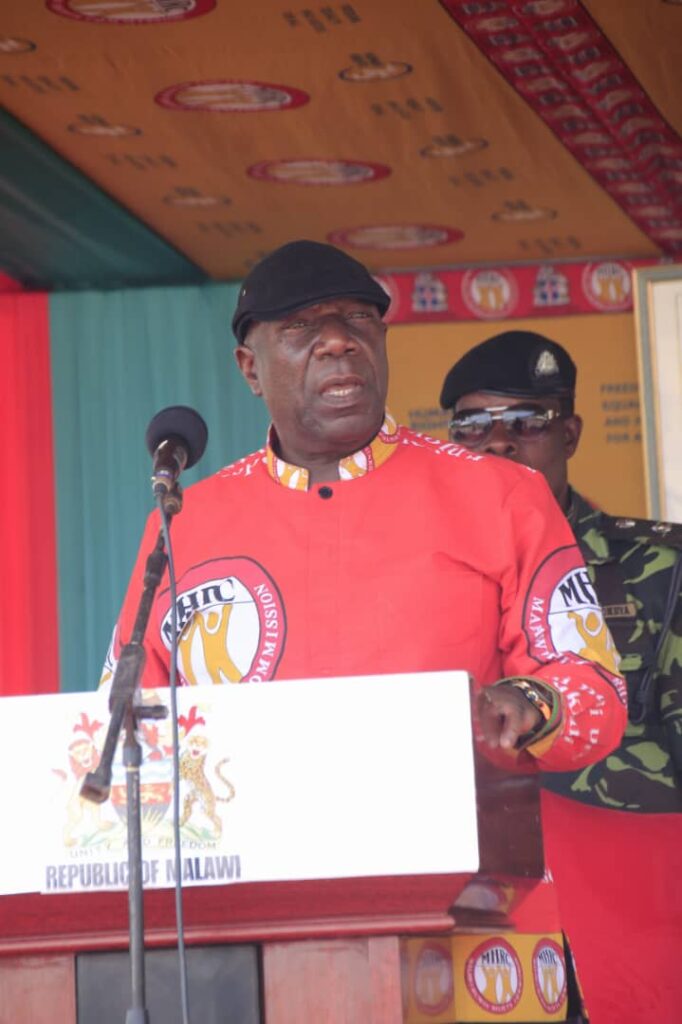
The most revealing contradiction lies at the heart of the reshuffle itself. Mutharika abolished one ministry but appointed four new deputy ministers. The net effect: the cabinet expanded from 24 to 28 members.
This directly contradicts repeated promises of austerity. Eliminating the Ministry of State was framed as fiscal discipline in an economy burdened by debt equal to 88 per cent of GDP and rising interest payments that crowd out spending on health and education.
Still the creation of four new deputy minister posts erased any savings. Subtraction came through addition.
Why expand the executive payroll while preaching restraint? Because deputy minister posts provide political leverage. They reward loyalists, balance regional interests, and widen the circle of officials personally indebted to the President.
Gangata’s demotion required compensation elsewhere. Coalition partners needed placating. Parliamentary arithmetic demanded careful management.
The question now is whether this reshuffle marks a brief consolidation phase before genuine reform, or the start of a more durable governing pattern in which executive control advances at the expense of institutional development.
For now, consolidation, not reform, defines the presidency.
