Peaceful queues gave the illusion of fairness. But cash handouts, partisan broadcasting, and the unchecked power of incumbency cast a long shadow over Malawi’s fragile democracy.
Malawians queued calmly at polling stations, but behind the order lay an election tilted by cash handouts, partisan broadcasting, and the weight of incumbency.
Despite a peaceful voting day, international observers raised doubts about fairness.
They warned that state resources and unregulated campaign money gave the ruling party a decisive advantage, deepening citizens’ skepticism that the vote could deliver change in a country facing economic collapse.
On the surface, the September 16 general election appeared successful. Balloting across all 28 districts was described by the EU Election Observation Mission (EU EOM) as “largely orderly and transparent.”
But observers also saw a blurred line between government and ruling party.
The contest pitted President Lazarus Chakwera of the Malawi Congress Party (MCP) against his predecessor, Peter Mutharika of the Democratic Progressive Party (DPP), in a nation worn down by crisis.
Inflation has climbed above 30%, fuel and food are scarce, and the World Bank estimates more than 70% of Malawians will soon survive on less than $2.15 a day.
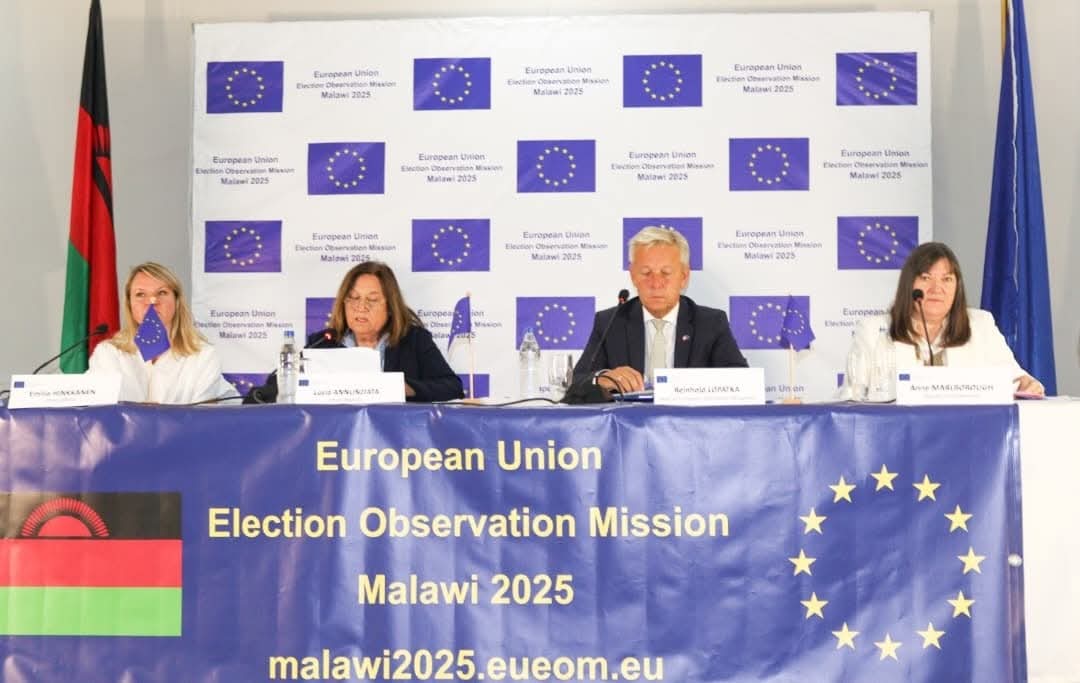
A preliminary EU statement, based on reports from 110 observers, said that while fundamental rights were upheld, “major imbalances undermined fairness.”
Chief Observer Lucia Annunziata pointed to biased state broadcasting and opaque financing that restricted “Malawians’ ability to make an informed electoral choice.”
The advantages of incumbency were visible everywhere.
The state-run Malawi Broadcasting Corporation ignored its legal duty of neutrality, granting Chakwera disproportionate airtime. Public vehicles and security forces were observed at campaign events.
Government programs, from inaugurating public works to funding Chiefs, were folded into campaign activity.
Equally damaging was the lack of campaign finance regulation. No limits exist on political fundraising or spending, and a 2024 study revealed loopholes enabling secret donations.
Despite laws requiring disclosure of large contributions, not a single declaration has been made. Cash and goods were handed out widely, in direct violation of the Political Parties Act.
The Registrar of Political Parties even warned the MCP to stop distributing money at State Residences.
Governance expert Henry Chingaipe argues that non-enforcement of campaign laws has entrenched a system where money, not ideas, determines access to power, pushing Malawi toward “kleptocracy.”
The electoral commission also came under fire. Though preparations were largely on schedule, it failed to publish clear tallying procedures. Confidence eroded further when Biometric Voter Verification Devices were rushed in with little transparency.
The High Court allowed their use but ordered results to be based on paper ballots, echoing memories of the annulled 2019 election.
While regional election staff were seen as impartial, disputes at the Commission’s leadership level fed opposition claims of bias.
Turnout dropped to 7.2 million registered voters, well below 2019 levels. Many Malawians saw little to vote for beyond a choice between hardship and more hardship.
With debt at 88% of GDP, growth projected at just 2%, and climate shocks hitting agriculture, survival outweighed ideology.
Yet campaigns failed to address these crises meaningfully, devolving instead into personal attacks.
As results are awaited, the pressing question is not just who won, but whether the victor can claim legitimacy, and whether they can govern a country sliding deeper into poverty.
As Reinhold Lopatka, Head of the European Parliament Delegation, put it: “For Malawians to keep their trust in democracy and elections, political parties should now focus on dealing with the dire economic situation and easing Malawians’ daily hardships.”
