Malawi’s 2025 election has exposed deep vulnerabilities in the country’s electoral technology and monitoring systems, raising urgent questions about transparency and democratic accountability.
As ballot counting continues following Tuesday’s general vote, a tangle of technical glitches, disputed systems, and observer findings has cast a shadow over what was meant to be a model democratic exercise in southern Africa.
At the heart of the controversy is the Malawi Electoral Commission’s (MEC) decision to deploy 6,500 Election Management Devices (EMDs) supplied by Smartmatic International Holding B.V., a Netherlands-based company with a contentious global track record.
Opposition parties, including the Democratic Progressive Party, United Transformation Movement, and Alliance for Democracy, mounted a last-minute court challenge, demanding an independent audit of the devices before polling day.
Justice Chimbizgani Kacheche presided over the case, where opposition leaders argued that MEC’s refusal to allow such audits violated constitutional guarantees of free and fair elections.
Their concerns focused on two issues: the use of EMDs for voter identification at polling stations and the electronic transmission of results.
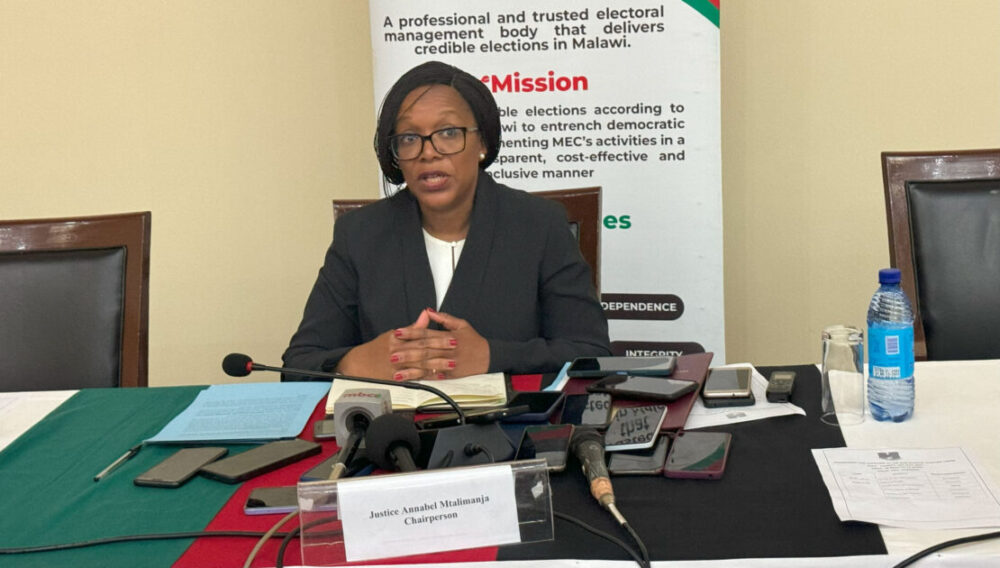
MEC Chairperson Justice Annabel Mtalimanja defended the system, insisting it complemented existing safeguards rather than replacing them.
“The Commission views the Election Situation Room as a complementary mechanism, not a parallel system, to support the overall electoral process,” she said.
Yet her assurances did little to ease fears about Smartmatic’s involvement.
Technical concerns became more visible during an August 27 dry run of the Results Management System, when network failures in Blantyre and Lilongwe delayed results transmission.
MEC downplayed the glitches, stressing that ballots remained paper-based and could be verified manually.
Meanwhile, Malawi’s civil society launched its most ambitious monitoring effort yet.
The National Initiative for Civic Education (NICE) Public Trust unveiled “Maso Athu” (“Our Eyes”), an Election Situation Room (ESR) designed to track incidents in real time.
The platform deployed more than 6,300 observers nationwide, including 509 roving and 639 stationed monitors, equipped with digital reporting tools.
NICE Executive Director Grey Kalindekafe described the initiative as “a pledge to safeguard our democracy, to protect the integrity of our elections, and to ensure that every citizen’s voice is heard.”
UN Resident Coordinator Rebecca Adda-Dontoh praised it as “a sanctuary for democracy, where truth is protected, where conflict is defused, and where the heartbeat of a nation is monitored with care and courage.”
But the ESR also faced limitations. Like the official results system, it depended on fragile digital infrastructure and mobile networks prone to disruption.
International observers added another layer of scrutiny. Six major missions, including delegations from the European Union, African Union-COMESA, and the Southern African Development Community (SADC), monitored the polls.
The EU mission, led by Chief Observer Lucia Annunziata, deployed 71 observers, while AU-COMESA brought 76 representatives from 27 countries under the leadership of former Ethiopian Prime Minister Hailemariam Dessalegn Boshe.
In a statement recalling Malawi’s 2019 elections, annulled by the courts after widespread irregularities, the SADC mission noted that the country had since “rectified these challenges through the appropriate national judicial mechanisms.”
Still, familiar problems resurfaced. Biometric fingerprint scanners malfunctioned at some stations, creating long queues. At several centres, voters unable to sign ballots resorted to using inked fingerprints.
Unofficial tallies suggested that former president Peter Mutharika was leading in some constituencies with about 30% of the vote, ahead of incumbent President Lazarus Chakwera.
But these early figures underscored another tension: the gap between unofficial results shared by media and civil society and the official results controlled by MEC’s centralised transmission system.
MEC insisted that its system was “fully verifiable,” but its tight control raised concerns about bottlenecks and opacity.
Low voter turnout compounded the unease.
Only 4 million of Malawi’s 7.2 million registered voters participated, a turnout of 56%, well below the 64% recorded in 2020.
Analysts warned that the decline reflected eroding public confidence in both electoral institutions and civic education campaigns.
Civil society organisations like the Centre for Democracy and Economic Development Initiatives (CDEDI) went further, urging MEC to cancel its contract with Smartmatic, which they called a company of “questionable character worldwide.”
CDEDI director Sylvester Namiwa was physically attacked during protests against MEC, illustrating the risks faced by activists.
The judiciary, anticipating disputes, launched specialised training to prepare judges for cases involving electronic systems.
Chief Justice Rizine R. Mzikamanda noted that while judges were not expected to be technology experts, they needed sufficient understanding to fairly assess disputes.
Malawi now awaits official results: September 24 for the presidential race and September 30 for parliamentary contests.
The stakes reach far beyond Malawi’s borders. The 2025 vote is being watched closely as a test of how emerging democracies in Africa manage the promises and pitfalls of electoral technology.
MEC’s gamble on Smartmatic may have been intended to boost efficiency and credibility, but the absence of transparent audits and widespread scepticism have instead created new vulnerabilities.
The Election Situation Room showed promise as an innovative form of participatory monitoring, yet it too was tethered to fragile infrastructure.
Its future effectiveness will depend on whether Malawi, and other nations that look to replicate it, can build robust, transparent, and accessible systems.
As UN Resident Coordinator Adda-Dontoh reminded the nation: “Every vote must count. Every voice must matter. Every Malawian, from Nsanje to Chitipa, must be protected in their democratic journey.”
Whether Malawi’s 2025 election will embody that democratic ideal remains an open question, but the challenges already exposed may help shape the future of electoral integrity across the continent.
