For generations, Malawians have waged relentless battles against malaria, HIV, and tuberculosis. Now, a new, insidious enemy has emerged from within the nation’s kitchens and crowded cities: diabetes and hypertension. As the ‘Warm Heart of Africa’ grapples with this silent epidemic, the race is on to rewrite the nation’s health narrative before a generation is lost.
By Collins Mtika
The queue outside St. John’s Hospital in Mzuzu snakes into the cool morning air, a familiar sight in a country long at war with infectious diseases.
But today, 58-year-old farmer Elina Gondwe is not here for Malaria, HIV, or TB. For months, fatigue clung to her. A thirst she could not quench. Blurry vision she blamed on age.
The diagnosis was a shock: Type 2 diabetes and dangerously high blood pressure.
“I thought these were diseases for rich people in the city, the ones who drive cars and eat meat every day,” she says, bewildered, clutching a slip of paper like it might explain everything. “We eat Nsima. It is our strength.”
Elina’s story is one voice in a rising chorus across Malawi. A quiet, creeping crisis of non-communicable diseases (NCDs) is reshaping the country’s medical landscape.
While international aid and government efforts have long focused on infectious diseases, hypertension and diabetes have quietly embedded themselves into everyday life.
The nation’s adult hypertension prevalence is estimated to be as high as 33%, with diabetes affecting 2-6% of the population. The battle is no longer just against pathogens from the outside, but habits from within.
The Nsima Paradox: when strength becomes risk
At the center of the crisis lies what public health experts call the “Nsima Paradox.” Nsima, the thick maize porridge that fuels nearly every Malawian meal, is more than food. It is identity, culture, and community.
“For our grandparents, a large plate of Nsima was necessary. They would spend eight hours tilling the fields under the sun,” explains Dr. Precious Kanyika, a Public Health Researcher in Lilongwe.
“Today, life is changing. Urbanization means more people have sedentary jobs. They ride to work. They sit at desks. They barely move. But the diet hasn’t changed. In fact, it’s gotten worse.”
This shift is a core feature of the “nutrition transition” occurring across Africa. The paradox is stark: what once built strength is now fueling weakness. The high caloric load of Nsima, once burned off through physical toil, is now stored as fat.
Add to that a flood of cheap cooking oils, sugary drinks, and ultra-processed snacks, now staples in urban kiosks and rural markets alike, and you have a recipe for a metabolic explosion.
A diet that was once high-fiber and low-fat is rapidly transforming, and it is transforming the population with it.
Quiet Warnings, Loud Consequences
The core challenge, experts argue, is not a lack of information but a failure to meet people where they are. Health messages about NCDs are often lost in translation.
English-language billboards at busy roundabouts that promote “healthy eating” feel abstract to villagers whose most urgent question is not what to eat, but whether they will eat at all.
“We are using Western templates for an African problem,” says Blessings Mwale, a communications officer for a local health NGO. “Telling someone to ‘eat a balanced diet’ is meaningless if their entire concept of a meal is Nsima with a small side of relish. We need to speak their language—literally and culturally.”
The consequences of this communication gap are dire. A landmark study by the Malawi Epidemiology and Intervention Research Unit (MEIRU) found that a staggering 58% of Malawians with hypertension are unaware they have it, earning it the grim title of “the silent killer”.
An opportunistic screening campaign in 2021 painted an even bleaker picture, with only 5.5% of individuals identified with high blood pressure being previously aware of their condition.
This is slowly changing. Local groups are now taking a hyperlocal approach.
In communities near the Khombedza Health Center, Radio Listening Clubs have begun performing role-plays and dramas about diabetes and hypertension in local languages, weaving health education into familiar forms of entertainment.
While healthy eating advice has long been a whisper, these efforts are helping it find its voice against the loud marketing of sodas and processed foods.
From Clinic to Community: the new Frontline
The fight is shifting from sterile hospital wards to churchyards and mango tree meetings. Community health workers (CHWs), the backbone of Malawi’s primary healthcare system, are being retrained.
Once focused on mosquito nets and vaccines, they are now being equipped with blood pressure cuffs and glucose meters.
This change is now official policy. The government’s National Community Health Framework for 2023-2030 formally tasks CHWs with screening for hypertension, diabetes, and obesity.
In districts like Thyolo, with support from UNICEF and USAID, CHWs are conducting door-to-door screenings, bringing early detection to people’s homes.
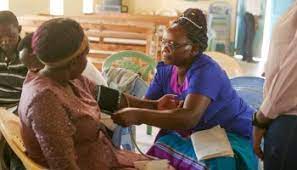
In a small village outside Zomba, a CHW named Jonathan Chaima sets up a folding table after Sunday service.

“At first, they were suspicious,” he says, wrapping a cuff around an elderly woman’s arm. “But when one person is found with high pressure and feels better after getting medicine from the clinic, their neighbor comes the next week. It’s about trust.”
These grassroots efforts are proof that prevention is possible. A pilot program in Neno District that expanded the role of CHWs to include NCDs successfully reduced the rate of patients defaulting from chronic care by approximately 20%.
The cost of a blood pressure pill can be mere cents; the cost of dialysis or stroke rehabilitation can wipe out a family’s entire income.
An Economic Crisis in slow motion
The stakes are not just personal; they are national. Non-communicable diseases are chronic conditions that quietly consume productive lives. They rob families of breadwinners and saddle a fragile health budget with long-term costs.
A study on the economic impact of NCDs in rural Malawi revealed that over 21% of households with a family member seeking care for a chronic condition faced catastrophic health spending, pushing them deeper into poverty.
“Every kwacha spent treating a preventable case of diabetes is a kwacha not spent on building a school or improving a road,” Dr. Kanyika states grimly. “We are on the verge of trading one public health crisis for another, and this new one could bankrupt our future before we even build it.”
A national response takes shape
For a nation chasing development, the silent epidemic of NCDs is a slow-motion economic landslide. However, the alarm is being heard. NCDs have been integrated into Malawi’s Health Sector Strategic Plan III (2023-2030).
In May 2024, the Ministry of Health and its partners officially launched the third phase of the national NCD response: the “Scaling up the Implementation Capacity for NCDs Prevention and Management Strategy.”
This ambitious four-year plan aims to expand access to NCD care at the primary level across the country, empowering the very community-based approaches that are showing promise.
Malawi’s greatest strength has always been its people.
Now, that very resource is under threat, not from a virus or a parasite, but from a diet unmoored from the lifestyle it once sustained.
Finding a new message of health, one that honors tradition while adapting to modern life, is no longer optional. It is a national survival manual.
