Quiet ownership changes, opaque mining deals and a collapsed IMF programme are reshaping Lilongwe’s most consequential foreign partnership
By Collins Mtika
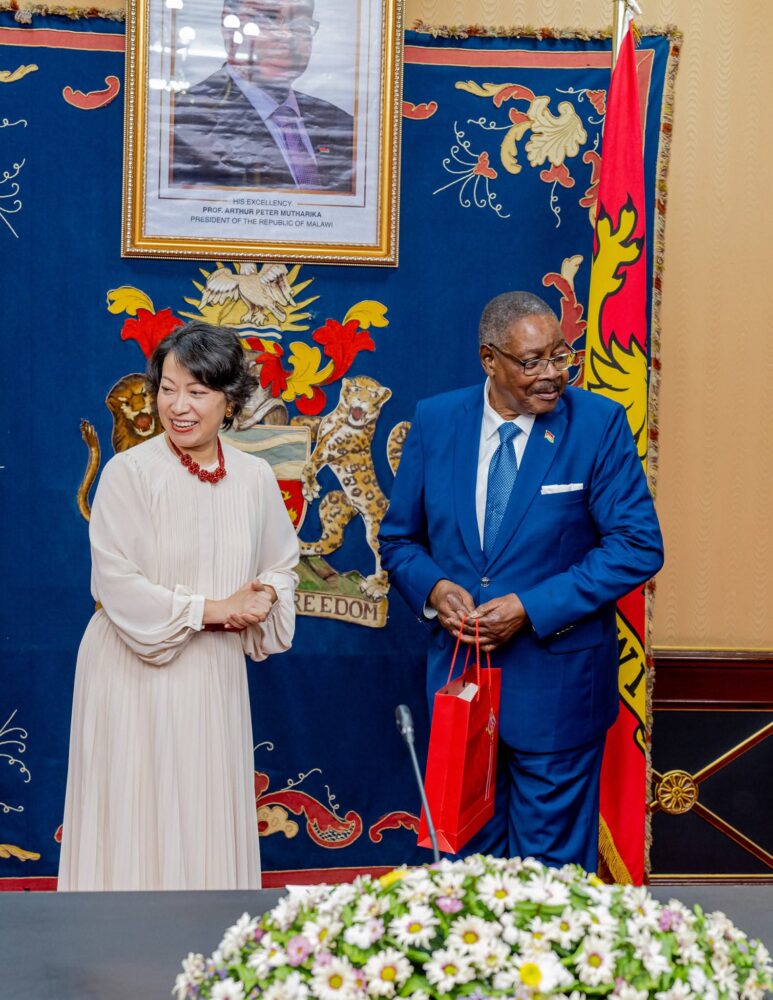
When President Arthur Peter Mutharika received Chinese ambassador Lu Xu at Kamuzu Palace in March, the official statement described the meeting in familiar diplomatic language.
The two spoke of strengthening bilateral relations. Mutharika thanked Chinese president Xi Jinping for a goodwill message and proposed expanding cooperation in education, science and technology.
But the meeting came at a moment when the foundations of Malawi’s relationship with China are quietly shifting, and when the country’s emerging mineral wealth is drawing unprecedented foreign interest.
Weeks earlier, Malawi and China had signed a 300-million yuan ($43-million) grant agreement to fund road construction and government digitalisation.
The deal arrived as Malawi’s economic crisis deepened.
According to projections by the World Bank, Malawi’s economy is expected to grow by just 1.9% in 2025, below population growth and marking a fourth consecutive year of declining income per capita. Public debt now approaches 90% of GDP, inflation exceeds 30%, and the country remains in external debt distress.
With Western lenders retreating and an IMF rescue programme collapsed, Beijing is emerging as Malawi’s most important financial partner.
At the same time, Chinese companies are rapidly positioning themselves inside a mineral sector that the government believes could transform the country’s economy.
The convergence of fiscal crisis and mineral opportunity is redefining the balance of power in one of Malawi’s most consequential bilateral relationships.
Malawi’s economic policy anchor unravelled in May 2025 when its $175-million Extended Credit Facility with the International Monetary Fund terminated after 18 months without a completed programme review.
Only $35 million of the facility had been disbursed. The collapse left Lilongwe with few options. Chinese financing, which typically arrives without the fiscal reforms demanded by multilateral lenders, now fills part of that gap.
The February grant agreement reflects a broader shift in Beijing’s approach to Africa: moving away from large sovereign loans toward grants, debt restructuring, and investment tied to natural resources and industrial development.
For governments under fiscal pressure, the model is politically attractive. For critics, it raises questions about transparency and long-term control of strategic resources.
Those concerns are becoming most visible in Malawi’s mining sector. In July 2025 the government announced $12 billion in Chinese mining and infrastructure transactions, one of the largest foreign investment commitments in the country’s history.
The agreements include a $7-billion titanium mining and processing project in Salima led by China’s Hunan Sunwalk Technology Group and a proposed $5-billion special economic zone in Chipoka linked to the project.
Government projections suggest Malawi could generate $30 billion in mineral exports between 2026 and 2040, a figure that would dwarf the country’s current economic output of roughly $18 billion, according to the IMF.
But the speed of investment announcements has outpaced the country’s regulatory capacity.
An investigation published earlier this year revealed that Chinese state-linked companies had quietly gained control of Mawei Mining Company, which holds a heavy mineral sands concession near Makanjira believed to contain more than 350 million tonnes of ore.
The ownership changes occurred through the company’s parent firm, Xinjin International, registered in the British Virgin Islands. Between 2023 and 2025 the firm changed ownership twice.
The transactions ultimately placed the Malawian project under the control of Shandong Zhaojin Ruining Mining Industries and Hainan International Resources, companies linked to Chinese state mining interests.

Malawian mining authorities later acknowledged they were unaware of the changes.
Under Malawian law, transfers of beneficial ownership require approval from the ministry responsible for mining. No such approval had been granted. The episode exposed a significant regulatory gap at the very moment Malawi is preparing for a mining boom.
In Makanjira, where the project is located, community leaders say the promised benefits have yet to materialise.
“Since 2017 our community has seen no tangible benefits from this project,” said ward councillor Abdullah Yusuf. “Many promises were made, but none have been fulfilled.”
Such frustrations are not unique. Across Africa, communities living near major mineral projects often see limited economic benefits while environmental and social impacts accumulate.
For Malawi, a country with little prior experience managing large-scale mining operations, the governance challenge is particularly acute.
The developments in Malawi mirror wider shifts in China’s economic engagement across Africa. At the 2024 summit of the Forum on China–Africa Cooperation in Beijing, Xi pledged $50.7 billion in financing for the continent over three years.
The summit also elevated China–Malawi relations to a strategic partnership.
China has since expanded trade access for African exports. Beginning in May 2026, least-developed countries, including Malawi, will receive zero-tariff treatment on all tariff lines entering the Chinese market.
Ambassador Lu has also announced the cancellation of $20 million in bilateral Malawian debt and the extension of repayment periods on remaining loans to 48 years.
But Malawian economists note that the relief is modest compared with the country’s total public debt of about K16.19 trillion, including roughly $300 million owed to China.
Grant financing also serves a strategic purpose.
By shifting away from large loans, which drew criticism under China’s Belt and Road Initiative, Beijing reduces accusations of “debt-trap diplomacy” while maintaining commercial advantages for Chinese contractors and suppliers.
Malawi’s mineral sector is now attracting attention from Western investors as well.
Australian company Sovereign Metals is developing the Kasiya rutile project, the world’s largest known deposit of the mineral used in titanium metal and high-grade pigments.
Meanwhile, Lindian Resources plans to begin rare-earth production at the Kangankunde project by late 2026.
These projects position Malawi within the global supply chain for minerals critical to renewable energy, aerospace and advanced manufacturing.
But they also place the country at the centre of an intensifying geopolitical contest between Chinese and Western resource investors. Over the next two years, Malawi’s mineral boom will test the strength of the country’s institutions.
The government is expected to seek a new programme with the IMF, raising questions about whether Lilongwe can reconcile fiscal discipline demanded by the fund with the political appeal of Chinese financing that carries no policy conditions.
At the same time, the mining ministry must rapidly expand its regulatory capacity.
If current projections hold, mining’s contribution to Malawi’s economy could rise from less than 1% of GDP today to about 10% by 2030. Such a transformation would reshape the country’s economic structure and the stakes of governance failures.
For policymakers, investors and citizens alike, the central issue is not how many deals are announced but who ultimately controls Malawi’s mineral wealth and under what rules.
The resources are real. Whether they deliver broad-based development, or simply deepen a new form of extractive dependency, remains an open question.
