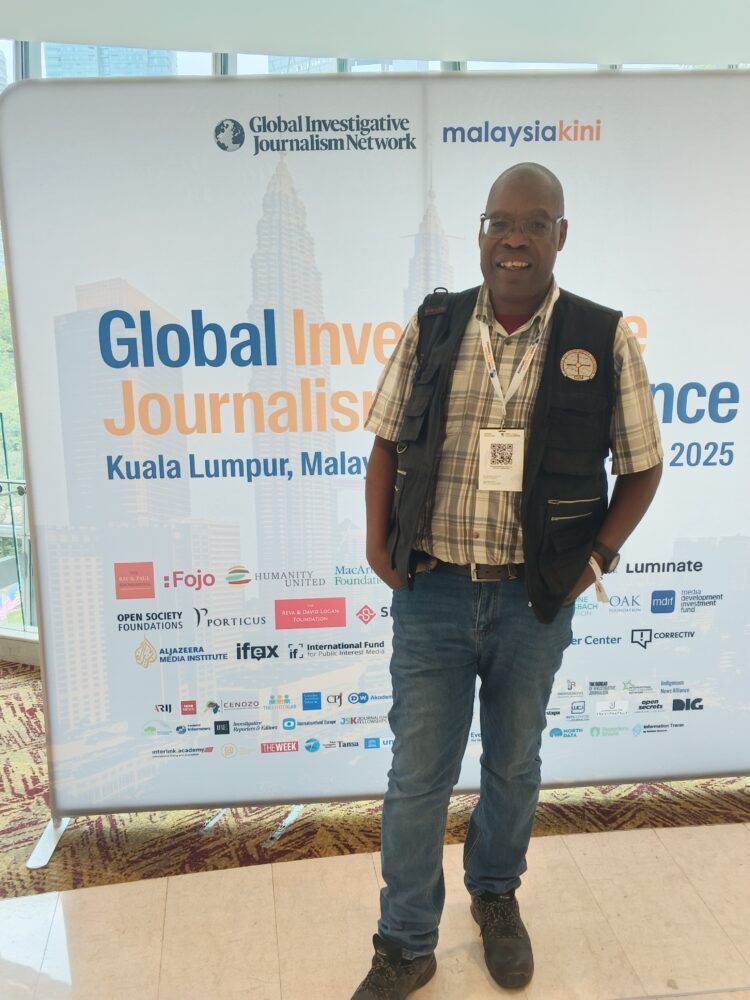
From OSINT to digital forensics, sessions spotlight tools for reporters under pressure.
By CIJM
For the first time since the conference’s launch in 2001, the Global Investigative Journalism Conference (GIJC) came to Asia, drawing more than 1,500 reporters and editors from over 100 countries to the Kuala Lumpur Convention Centre from 20 to 24 November.
Co-hosted by the Global Investigative Journalism Network (GIJN) and independent Malaysian newsroom Malaysiakini, the biennial meet leaned into training, collaboration and survival strategies for watchdog reporting in hard times.
Malawi had a seat at the table: Collins Mtika of the Centre for Investigative Journalism Malawi (CIJM) was among the journalists awarded fellowships to attend, part of GIJN’s push to widen access for newsrooms across the Global South.
GIJN’s programme again prioritised bursaries for under-represented reporters, underscoring a steady shift in investigative muscle beyond traditional strongholds in North America and Europe.
Across five days, more than 150 panels and workshops ranged from OSINT and AI-assisted reporting to digital security, cross-border collaborations and data verification. The emphasis was pragmatic: build skills, harden security, and find partners.
The setting mattered, too. Malaysiakini, founded in 1999 as an online operation to dodge legacy licensing controls, stood as a case study in surviving state pressure while maintaining reader-funded independence.
The stakes were never merely academic. Reporters Without Borders’ 2025 World Press Freedom Index places a majority of Asian populations inside “very serious” press-freedom environments; seven of the world’s 10 worst performers are now in Asia.
That backdrop framed sessions on risk, legal defence and newsroom resilience. What kept delegates in their seats was the blend of tools and tactics.
Trainers walked through geolocation and image forensics; editors unpacked cross-border collaborations that pierce shell companies and procurement scams; product sessions demoed scraping and verification workflows that can be replicated inside resource-strapped newsrooms.
GIJN’s fellowship schemes, backed by partners, remain a force multiplier, seeding networks that outlast any single conference.
The KL edition also doubled as a regional barometer. Southeast Asia’s media landscape is increasingly constrained, yet Malaysiakini’s quarter-century survival shows how digital-first, subscription-supported outlets can hold the line.
For African delegates, the through-line was familiar: shrinking ad markets, legal harassment and the grind of funding investigative beats.
Panels on business models took a clear-eyed view, do not wait for a saviour; diversify revenue, measure impact beyond clicks, and keep the reporting sharp.
GIJC wrapped on 24 November with the Global Shining Light Awards, honouring investigations undertaken in volatile or rapidly changing conditions, work that often lands far from donor capitals yet shifts national conversations at home.
For Mail & Guardian readers, the takeaway is equal parts caution and momentum. The caution: the economics of journalism are wobbling and the legal climate is worsening.
The momentum: skills, alliances and a widening pool of fellows, Malawi’s Mtika among them, are knitting together a cross-continental spine for accountability reporting.
In Kuala Lumpur, the message was unambiguous: in an era of intimidation and information chaos, the craft’s core remains stubbornly practical, verify, collaborate, follow the money, and keep publishing.
Editor’s note: GIJC25 took place at the Kuala Lumpur Convention Centre, 20–24 November 2025; full programme details and fellowship information are available via GIJN.
