By Jack McBrams
They say, “Show me your friends and I’ll tell you who you are.” If that timeless proverb holds even a sliver of truth, then President Lazarus Chakwera might want to delete half his contact list and rethink who he’s letting through the gates of Kamuzu Palace.
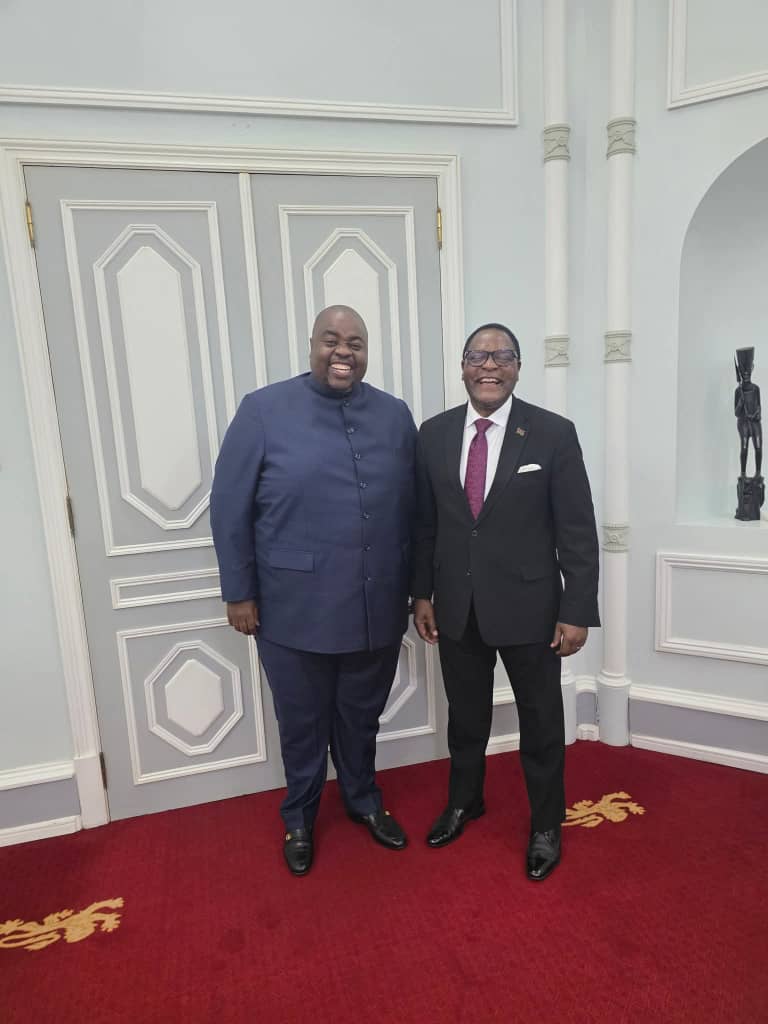
A photo has been making the rounds over the last 24 hours—our Head of State grinning from ear to ear beside Zimbabwe’s flashy controversy magnet, Wicknell Chivayo.
A man whose past includes a stint in prison for fraud and whose present involves giving away luxury cars like confetti, basking in the aura of political patronage, and raising suspicions of money laundering on a grand scale.
In Zimbabwe, Chivayo is either a misunderstood tycoon or a high-rolling crook—it depends on which side of the cash transfer you’re standing on. But in Malawi, he’s just another dubious guest with presidential proximity.
The picture itself was bad enough. But the bigger question is this: Who books the President’s appointments? Who clears these characters to sit across from the most powerful man in the land? Does State House conduct any background checks at all? Or is it now the norm for anyone in a shiny suit with a dodgy business proposal to waltz into State House and walk out with selfies and, in some cases, diplomatic passports?
Let’s not forget the case of Dozy Mmobuosi, the smooth-talking Nigerian businessman who met Chakwera—and was granted a Malawian diplomatic passport two hours later. That’s not efficiency; that’s state-sponsored gullibility.
Mmobuosi now faces up to 45 years in a U.S. federal prison for allegedly masterminding one of the most brazen securities fraud schemes in recent memory. According to the indictment, his financial statements were nothing but window dressing—his companies were portrayed as cash-rich empires when, in truth, they were rickety houses of cards.
And then, in one of the more bizarre chapters of this presidency, there was Willie Steenkamp, alias Dr. William Bilderberg—a South African fugitive and Ponzi schemer who somehow ended up with a Malawian passport and an apparent seat at the table.
Before his arrest, he attempted to inject K22 billion into Malawian banks, a scheme only halted thanks to a few alert folks at the Financial Intelligence Authority. How many others slipped through?
Before that, there was the Bridgin Foundation—a supposed $6.8 billion “gift” from a mysterious Belgian entity. President Chakwera, full of fanfare and false hope, declared it “an early Christmas.” He even called it the most “momentous” development initiative in Malawi’s history. Turns out it was about as real as Santa Claus. Bridgin was nothing more than a polished scam, and the only thing it successfully funded was national embarrassment.
And the rot doesn’t stop with outsiders. The president’s own chief of staff, Prince Kapondamgaga, was exposed for accepting a luxury Mercedes Benz from corruption kingpin Zuneth Sattar. Rather than face prosecution, he surrendered the car, signed a “restitution agreement,” and kept his skin and, conveniently, his job. No charges, no accountability. Just a gentleman’s handshake with the Anti-Corruption Bureau. What message does that send to the nation? That crime pays, as long as you say sorry?
The Chakwera administration has shed top aides like snakeskin. Pastor Martin Thom was booted for sneaking a loan bill into Parliament. Chris Chaima Banda is on trial for allegedly attempting to manipulate fuel contract awards.
Adamson Mkandawire, a senior presidential advisor, was sued for soliciting a K378 million loan from businessman Abdul Karim Batatawala, name-dropping the president and other top officials to grease the deal.
With each of these scandals, State House scrambles to assure us that the President was “unaware” or “misled.” But there are only so many times one can claim to be hoodwinked before the story becomes absurd. Is Chakwera’s inner circle so blind, or is this willful ignorance dressed up as trust?
And here lies the deeper danger: Malawi risks becoming a laundromat for the world’s dirtiest money. With weak due diligence systems, a lack of transparency, a proclivity for free handouts masquerading as manna from heaven, and a leadership too eager for headlines and handshakes, our country is turning into a soft target. A haven where international fraudsters set up ghost businesses, pose for photographs with government leaders, and quietly siphon their dirty money through “investments” that never materialize. They walk away richer, cleaner—and our nation, poorer and more humiliated.
This is not just about optics; it is about the very soul of governance. Every handshake with a conman devalues the dignity of the presidency. Every photo op with a crook chips away at national credibility. Every soft landing for a well-connected fraudster is a stab in the back of ordinary Malawians who pay taxes, struggle for jobs, and dare to believe in a better country.
President Chakwera campaigned on a platform of integrity, morality, and transformation. But somewhere between the pulpit and the palace, that promise got lost—buried under a mountain of fraud, scandal, and self-inflicted shame.
Mr. President, your friends are telling us who you are. And we are listening.
