By Collins Mtika
Abraham Siliwonde does not know what uranium is used for. But he is certain that radiation made him blind and reduced him to a pauper. He now relies on well-wishers and his wife’s small business to survive.
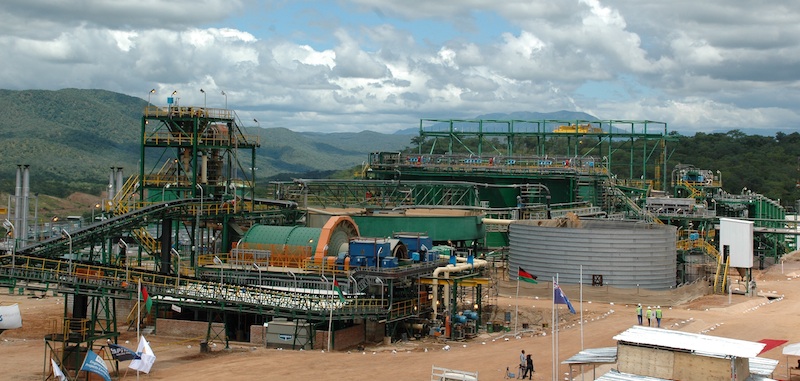
Siliwonde used to work at Kayelekera Uranium Mine in the northern district of Karonga, about 600 km from the capital city of Lilongwe.
“I was guiding dumpers carrying high-grade uranium ore. I could feel intense heat from lumps of uranium ore, and the next day I would pass yellowish urine and start feeling malarial symptoms,” he told a local daily.
It did not take long before he started experiencing sight problems, that sometimes he could fail to recognise some of his long time colleagues. This negatively affected his performance at work.
Because of his condition, the company fired him and gave him MK75, 000 ($150) as a retirement package. Together, with his family of 11, he now lives in a rented derelict house in the district town.
In his medical report, Chief Ophthalmologist at Lions Sight First Eye Hospital in Lilongwe, Dr. Joseph Msosa, links Siliwonde’s eye problem to radiation.
“The vitritis (posterior uveitis) may indeed be due to exposure to radiation. It is well known that all radioactive substances can cause radiation retinopathy, which appears like posterior uveitis. reads the report in part.
In normal cases, Siliwonde’s could have been given the deserving package, but General Manager for International Affairs Greg Walker at the mining company said the company could not give him the full package because he was an employee for one of the companies it contracted.
Another former employee, Francis Mkonda, was fired on his hospital bed when recuperating from severe injuries he sustained while at work at Kayelekera Mine.Mkonda, who worked as a processor operator, collapsed at work on January 13, 2013.
The company fired him on January 24, 2013, citing huge hospital bills, saying it was constrained financially and hence could not pay.
He died a few days later after receiving the dismissal letter at the hospital.Siliwonde and Mkonda are just a microcosm of the many employees who were happy to get work at Kayelekera Uranium Mine but left forsaken, disgusted, or died paupers.
The Kayelekera Uranium Mining project was commissioned in 2007 after the Malawi government awarded a uranium mining license to Paladin Africa Limited (PAL), an Australian and Canadian registered company.
The permit covered 5,550 hectares for a period of 15 years following the completion of a development agreement
Paladin has consistently stated that it is making a big investment in Malawi, that the country is benefiting from a variety of revenue streams, and that it has not yet earned ‘a single Kwacha’ in return on its investment.
In February 2014, PAL suspended operations and put the mine on what it called ‘care and maintenance’. It also lay off the bulky of its employees, about 300 people.
The company cited the declining price of uranium on the global market in the aftermath of the Fukushima nuclear disaster in Japan in 2011.
However, in its quarterly activities report dated December 31, 2014, it states that it has started a feasibility study to develop a detailed plan for the recommencement of production at Kayelekera when uranium prices justify.
And at Kanyika Area in Mzimba District, northern Malawi, about 250 km from the capital city Lilongwe, communities here have been drinking water contaminated with hazardous metals, courtesy of another Australian mining company Globe Metals and Mining Limited.Globe Metals and Mining will mine Niobium, a critical additive in the production of sophisticated steels.
The Kanyika Mining Project will be the second major mining operation in the country after the Kayelekera Uranium Mine in Karonga district.
“What else can we do? This is our land. Before Globe came, we were drinking safe water. Now they are telling us that this water has uranium; to be very frank, then they should give us safe water,” said a villager who preferred anonymity.
Australian mining companies are accused of involvement in the killing and maiming of miners and residents across Africa through dangerous, unsustainable, and illegal mining practices.
The Federal and Queensland governments have recently been, or still are, shareholders in some of these companies.
There are over 300 Australian stock market-listed companies in Africa—more than any other country—and nearly 35 of them have been implicated in allegations of corruption, tax avoidance, environmental destruction, and human rights abuses.
The Greens’ former senator Scott Ludlam in question No. 331, asked the Minister for Foreign Affairs on 6 December 2010 whether there was a need for Australia to legislate extra territorially its mining companies operating overseas so that they operate in line with Australian human rights and environmental standards rather than those of the host state.
“Australian companies are responsible for ensuring they abide by the laws of the jurisdiction in which they operate as well as Australian laws that apply extraterritorially. The Australian Government expects all Australian companies to comply with all applicable laws and obligations when operating abroad and to conduct their business according to best practice,” said former Senator Stephen Conroy on behalf of the Foreign Affairs.
But in Malawi they seem to work with impunity by blatantly disregarding the law because Malawi still uses a 34-year-old mining law that has several deficiencies.
Malawi is blessed with significant quantities of coal, limestone, niobium, rare earths, bauxite, nickel, and precious gems such as rubies, sapphires, diamonds and heavy mineral sandsaccording to a World Bank report, Malawi Mineral Sector Review: Source of Economic Growth and Development and also results from the country’s recent geological mapping exercise.
Malawi enacted its Mines and Minerals Act in 1981, long before the country charted any of its mineral resources.
But the Act has several deficiencies that have provided fertile ground for corruption, profit shifting, and tax evasion.
For instance, it vests the power in the President to grant mining licences with no consultation required with other stakeholders; it allows mining companies to operate by bilateral negotiations rather than consistent application of the law, which means some companies may get special favours.
And it also lacks provisions to maximise benefits for the country, such as requiring certain proportions of supplies to come from Malawi and also ensuring that communities benefit from mining revenue. It is also devoid of measures to protect people displaced by mining and health and safety regulations for specific mineral extractions.
Since 2000, Malawi has issued more than 172 mining licences to boost and diversify its economy, which depends largely on tobacco. Atupele Muluzi, the natural resources, energy, and mining minister, acknowledged the mining law’s flaws.
Muluzi noted that Malawi had several mining operations, saying there is a need to learn from such operations and improve things where there is a need.
“This is why we have been reviewing the legislation to address the deficiencies that have impeded development of the sector and align it with the aspirations of Malawians,” Mr. Muluzi was quoted by Mining in Malawi.
In January 2013, the government kicked off the process of overhauling the mining law by approving a new Mines and Minerals Policy. But scores of villagers at Kanyika and elsewhere where there are mining operations are not convinced with both Muluzi’s explanation and the pace of the review of the mining legislation.
“We feel the government has ignored us for long. The mine has created hunger in the area. Some of the people abandoned their gardens in anticipation of relocation and compensation. Why is it taking this long to be compensated?” Village Headman Yohane Mphepo told the Nation Newspaper.
Here the villagers feel cheated and have been demanding answers to a litany of issues, such as lack of consultations, what the government is doing about the environmental impact assessment, issues of safety, and the mining company’s commitment to corporate social responsibility.
“We suspect some foul dealings. There is no safety for us. There was no transparency…from the beginning. People do not know the merits and demerits of this mine. We do not have to ask for this information but it is given to us freely,” another village headman, Kawaghe Nkhoma, said.
Muluzi said Malawi will also review the Mines and Occupational Health and Safety Act, just like other countries have done.
The Fund for Investigative journalism (FIJ) funded this story
