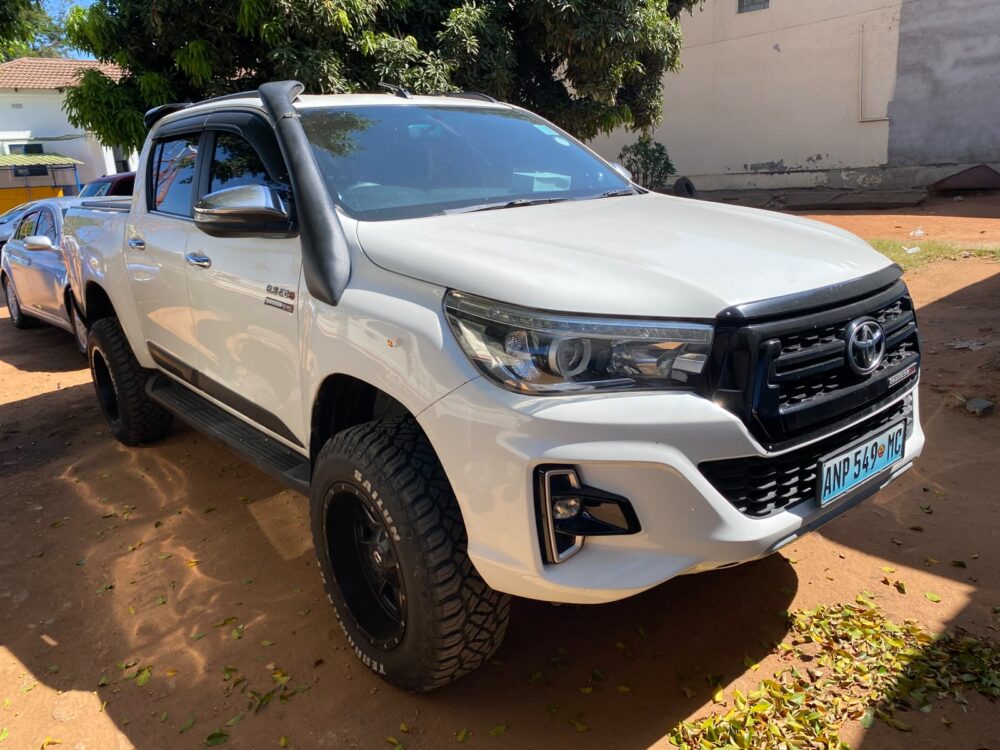
Customs documents identify the magistrate as the importer of a vehicle allegedly stolen in Durban. An invoice attributed to GOGO MOTORS shows an address in Johannesburg that cannot be located, an apparently invalid phone number, and a value far lower than that declared at the time of import. More than a year after INTERPOL alerted SERNIC, South African authorities travelled to Mozambique and took the car back to South Africa.
The white Toyota Hilux that was at the center of an investigation by the Center for Investigative Journalism (CJI), involving Judge Bruno Muhate and the insolvency of Cimentos da Beira ( see here ). here and (here ), it was recovered in Mozambique by representatives of the South African Police Service (SAPS), with the intervention of INTERPOL, and taken back to South Africa.
The operation represents a new development in an investigation that began with the disappearance of the vehicle in Durban in August 2024, and which revealed a chain of import documents to Mozambique in the name of the then judge of the Commercial Section of the Judicial Court of the Province of Sofala.
Documents consulted by the CJI, including customs declarations, commercial invoice, road manifest and bank documentation, identify Bruno Muhate as the importer of the Toyota Hilux, which began circulating in Mozambique with the license plate ANP549MC.
However, the document analysis raises further doubts about the commercial invoice itself presented in the import process.
The document, attributed to the South African company GOGO MOTORS, contains an address that the CJI was unable to confirm in Johannesburg, an apparently invalid telephone number, and a business identification number that does not correspond to the activity of the only company with the same name located in South Africa.
The international recovery of the vehicle therefore raises new questions about customs control, the authenticity of the documents used in the import, and the response of the Mozambican authorities to an INTERPOL alert issued in January 2025.
The disappearance in Durban and the journey to Mozambique
On August 2, 2024, South African Tyron Musimani reported to the authorities the disappearance of his white Toyota Hilux, license plate ND 525431, which was registered in the name of the company Tye Properties (Pty) Ltd.
According to the South African police report obtained by CJI, the vehicle was parked on an avenue in Durban at around 6:30 pm. When Musimani returned, about 50 minutes later, the police car was no longer there.
The car, purchased in 2020 for R585,000, had chassis number AHTHA3CD803436600 and engine number 1GD0837023. The CJI investigation identified the police report under reference HARTBEESPOORTDAM 20/8/2024.
Two months after its disappearance, the same Toyota Hilux appears in the import documentation for Mozambique, having entered through International Automobile Terminal 2 in Maputo.
The transaction was processed in October 2024 through the South African company GOGO MOTORS, identified as the exporter, and with the involvement of customs broker Lucas Zingai Quembo Nhandiro.
Customs documentation points to Bruno Muhate.
The declaration processed through the Electronic Single Window (JUE) identifies Bruno Muhate as the importer of the vehicle, with Tax Identification Number (NUIT) 101735753.
The document indicates that the declaration was submitted on October 11, 2024, and that payment was made on October 14 of the same year. The vehicle was declared at a value of 315,000 rand, equivalent to 1,165,500 meticais. Including freight and insurance, the declared CIF value totalled 1,171,050 meticais.
The documentation also indicates a payment of R$ 595,952.40 in royalties and other charges.
Commercial invoice no. 1603, issued to GOGO MOTORS and dated June 2023, also identifies Muhate as the consignee of the Toyota Hilux, with a value of 70,000 rand.
The road manifest confirms the transport from Durban to Maputo, while the bank intermediation agreement identifies Muhate as the importer and GOGO MOTORS as the exporter.
The documentation thus establishes a formal link between the magistrate and the vehicle import operation.
However, there is a significant discrepancy between the values presented in the documents. While the commercial invoice indicates 70,000 rand, the customs declaration shows 315,000 rand.
The difference of R245,000 requires clarification regarding the formation of the declared value, the nature of the invoice, and the criteria used in the customs assessment.
There is also a chronological issue: the invoice is dated June 2023, more than a year before the alleged theft, which occurred in August 2024. It is necessary to understand the nature of this document, the actual date of the transaction, and the commercial relationship between the exporter and the importer.
GOGO MOTORS: Address and phone number raise questions about invoice.
Analysis of commercial invoice no. 1603 revealed other elements that call into question the reliability of the identification of the company presented as the exporter of the Toyota Hilux.
The document indicates Beach Road in Johannesburg as the business address for GOGO MOTORS. However, checks carried out by the CJI did not locate a street with that designation in that South African city.
Research into the company’s existence revealed another inconsistency. The only entity identified in South Africa with the name GOGO MOTORS is dedicated to tire repair and is not based in Johannesburg, making it impossible to confirm that it corresponds to the company appearing on the invoice used to import the vehicle.
The phone number listed on the same document also raises questions. The sequence has extra digits and, according to checks carried out by the CJI, does not correspond to a valid phone number.
These inconsistencies are particularly relevant because GOGO MOTORS appears in the documents as the entity responsible for exporting the car from Durban to Maputo.
The question is who actually issued the invoice, which commercial entity was behind the transaction, and whether the company presented as the exporter actually existed and was authorized to carry out that transaction.
It’s not just a discrepancy in dates or values. The very commercial identification of the entity that supposedly sold and exported the vehicle needs confirmation.
The CJI therefore considers it necessary for Customs to clarify whether the legal existence of GOGO MOTORS, the validity of the invoice, the business address, and the correspondence between the exporter’s data and the documentation presented in the import process have been verified.
The potential confirmation that the invoice does not correspond to an identifiable commercial entity may have implications for assessing the regularity of the entire procedure.
An INTERPOL alert that reached SERNIC in January 2025.
One of the most relevant elements of this investigation is the communication from INTERPOL addressed to the National Criminal Investigation Service (SERNIC) of Sofala.
The communication dated January 29, 2025, and identified with the number 16/Inpl/Moz/2024, reported that a vehicle with characteristics matching the Toyota Hilux stolen in Durban was in the possession of Judge Bruno Muhate.
The CJI revealed this element in its investigation published in 2025, raising questions about the response of national authorities.
The information was particularly relevant because the vehicle had already been brought into Mozambique, undergone an import process, and been assigned a national license plate.
More than a year later, SAPS representatives, with the intervention of INTERPOL, went to Mozambique and took the vehicle back to South Africa.
This development raises an unavoidable question: what steps were taken by the Mozambican authorities between receiving the international alert and the actual recovery of the car?
The CJI aims to clarify whether SERNIC initiated a formal investigation, whether customs authorities were notified, and whether any steps were taken with the Sofala Provincial Court.
It is also important to know whether the information transmitted by INTERPOL was compared with the documents that supported the importation and whether the circumstances under which the vehicle began circulating in national territory were investigated.
Responsibilities in the import process
The CJI investigation had previously obtained clarifications from the customs broker. Lucas Zingai Quembo Nhandiro confirmed that he handled the import procedures for the Toyota Hilux.
In his explanation, the customs broker described the usual sequence of the process: commercial invoice, bank commitment agreement, road freight manifest, payment of duties, Single Document, and exit authorization.
The professional maintained that his role was limited to documentary and administrative intermediation between the importer, the bank, and the Internal Revenue Service.
In his explanation to the CJI, he assigned to Customs the responsibility of verifying the documents, assessing the customs value, comparing the documentary data with the physical characteristics of the vehicle, and conducting due diligence on the legality of the vehicle in the country of origin, including checking for any record of theft.
This explanation makes it particularly important to understand the procedures actually followed in the case of the Toyota Hilux.
If the vehicle was already registered as stolen in South Africa, it is important to know what verification mechanisms were used during importation and whether any warning information was available to Mozambican authorities at that time.
The issue takes on a different dimension when doubts arise regarding the commercial invoice. How was a document validated when its address, phone number, and business identification are inconsistent?
It is also necessary to clarify when Customs became aware of the INTERPOL communication and what measures were taken after receiving it.
A second question: who was the registered owner of the vehicle in South Africa?
The documents submitted to the CJI raise another issue related to the chain of ownership.
The original investigation identified Tyron Musimani and the company Tye Properties (Pty) Ltd as the owners of the Toyota Hilux that disappeared in Durban.
Meanwhile, a South African registration certificate included in the most recent set of documents identifies CHISSICO HL as the registered owner and displays the license plate HZN190L.
The certificate identifies the vehicle as a 2020 Toyota Hilux and contains references to the chassis and engine numbers, which should be compared with the original records.
The difference between registered owners and vehicle registrations requires documentary explanation. It is necessary to determine if there was a transfer of ownership, change of registration, or other registration operation prior to the vehicle’s disappearance.
The recovery of the car by SAPS may help clarify this issue through the official registration history and physical identification elements of the vehicle.
The insurance company and the right to recover the vehicle.
In the previous investigation, Tyron Musimani expressed to the CJI his desire to recover his vehicle.
However, information has emerged suggesting that the businessman may have received compensation from the insurance company following the alleged theft. The CJI has not yet been able to obtain documentation to confirm this information.
If compensation was paid, it will be necessary to clarify whether the insurance company acquired rights to the vehicle and whether it participated in the international recovery process.
The issue is not merely commercial. The ownership of the vehicle and any rights held by the insurance company may determine who is entitled to claim reimbursement.
CJI tried again to contact Musimani but received no response.
The antecedent of Cimentos da Beira
The investigation into the Toyota Hilux arose in the context of a series of CJI (Centre for Judicial Investigation) reports on the insolvency of Cimentos da Beira and the judicial intervention of Bruno Muhate.
In March 2026, the CJI published an investigation into the conclusions of the Superior Council of the Judiciary (CSMJ), which considered that the magistrate had committed legally unfounded acts and violated professional duties inherent to the exercise of the judicial function.
The sanction imposed resulted in his demotion from provincial judge to district judge.
The insolvency of Cimentos da Beira also had consequences for legal professionals. In June 2026, the Jurisdictional Council of the Mozambican Bar Association imposed suspensions of up to ten years on six lawyers involved in the process.
The Toyota Hilux case, however, constitutes an independent investigation, with its own documentary evidence and a dimension of international police cooperation.
In this case, his connection to the magistrate stems from the explicit identification of his name in the import documentation.
A recovery that doesn’t end the questions.
The transfer of the Toyota Hilux to South Africa constitutes a significant development, but it does not resolve the issues raised by the investigation. On the contrary, it opens a new phase in clarifying the vehicle’s origin, the chain of ownership, the authenticity of the commercial documentation, the import procedures, and the institutional responsibilities.
CJI intends to obtain clarifications from SERNIC, Mozambique Customs, SAPS, and the entities involved in the international recovery operation.
They also want to hear from Bruno Muhate regarding the acquisition and importation of the vehicle, the circumstances under which he began using it, and his knowledge of its origin.
Despite several attempts to contact him over various days, the magistrate did not respond to our team’s calls. The CJI remains available to hear his version of the facts and any clarifications he wishes to provide.
The seizure and transfer of the car do not, in themselves, constitute proof of the magistrate’s criminal liability. That determination rests with the competent authorities, through investigation and verification. However, the documents already known raise questions that require answers.
How was it possible for a car allegedly stolen in Durban to enter Mozambique through a formal import process? Who issued the commercial invoice attributed to GOGO MOTORS, and how was that company’s identity confirmed? Why does the document show an unlocatable address, an apparently invalid phone number, and a value substantially different from that declared to Customs? What happened to the INTERPOL alert sent to SERNIC in January 2025? And why was an operation involving authorities from both countries necessary to recover the vehicle?
The journey of the Toyota Hilux, from Durban to Maputo and back to South Africa, has become a case that goes beyond the story of a car. It is also a test of the capacity of institutions to cooperate, supervise and respond to alerts about goods allegedly originating from criminal activities.
More than clarifying who used the vehicle, it is now important to understand who introduced it into the commercial circuit, with what documents, and under what control mechanisms. After all, the legality of an import is not limited to the existence of a customs declaration: it also depends on the authenticity and reliability of the supporting documents.
