By Estacio Valoi and Luis Nhanchote
In a recent consultation of the website of the Ministry of Mineral Resources and Energy (MIREME), the Center for Investigative Journalism of Mozambique (CJIM) identified a new configuration of mining concessions previously granted to Haiyu Mining, Lda, a company linked to the corporate structure of the Chinese company Great Wall Mining Investment.
The titles that previously appeared associated with the mining company now appear under the control of MIREME, in a change whose nature, basis and consequences have not yet been officially clarified.
Without any public statement from the ministry regarding the operation and given the apparent continued presence of the Chinese multinational on the ground, questions are multiplying. How was this reversal carried out? Is it a definitive withdrawal of the concessions, an administrative suspension, or a reorganisation of the mining titles?
And, above all, what will be the future of mining in an area where the company has been suspended for more than two months and was previously fined seven million meticais for non-compliance with legal requirements, including issues related to environmental licensing?
The lack of official clarification leaves a fundamental question open: will the mining company be able to resume operations, or does this process represent the beginning of the end of its presence in Vilankulo?
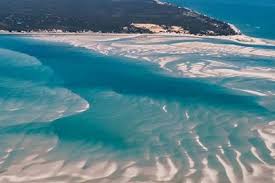
The uncertainty is not limited to the company’s future. It extends to the workers, the local communities, and a particularly sensitive coastal ecosystem, where dunes, mangroves, coral reefs, and ocean currents are interdependent components of an environmental and socioeconomic balance upon which tourism, a source of income for thousands of people, also depends.
This year, a CJIM team was in the field and observed the intensity of the extraction operations. On the coastal dunes, the activity was visible: excavations, constant truck traffic, and the systematic removal of sand from natural formations that act as barriers against coastal erosion.
These dunes are not just accumulations of sand.
They constitute natural infrastructure protecting the territory, and their destruction can exacerbate the vulnerability of the coastline. https://cjimoz.org.mz/news/o-modelo-por-tras-da-extracao/ Its removal raises an unavoidable question: who is monitoring the environmental impacts, and with what independence?
Environmental licensing remains among the most controversial aspects of the project. Local sources and civil society organisations have questioned whether the Environmental Impact Study was properly validated, whether the public consultations were effectively inclusive, and whether the environmental conditions established by the authorities are being met.
This year, CJIM published the first of a series of three investigations into heavy sand mining in Vilankulo, the first cycle of which was completed in June. The work revealed the dimensions of a mining operation installed in one of the most emblematic tourist destinations on the Mozambican coast, known internationally as one of the main gateways to the Bazaruto archipelago.
Since 2025, heavy machinery has been operating on the coastal dunes of this district in Inhambane province. The extraction of heavy sands progressed without a public debate proportionate to the scale of the undertaking.
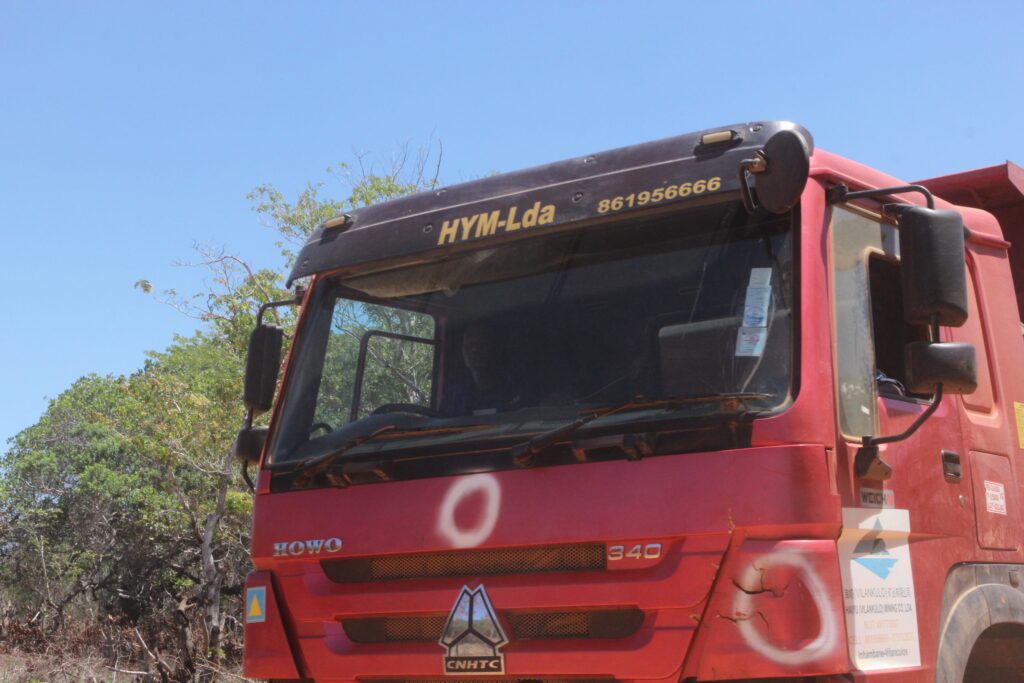
On the ground, however, the transformation of the landscape was evident. Excavators advanced over the dune formations, trucks circulated between the extraction areas, and residents reported restrictions on movement near the concession zones.
The operation was conducted by Haiyu Mozambique Mining Co. Ltd., a subsidiary of a mining group with mostly Chinese capital, holding concessions for the exploration of minerals such as ilmenite and zircon, raw materials in demand in international markets.
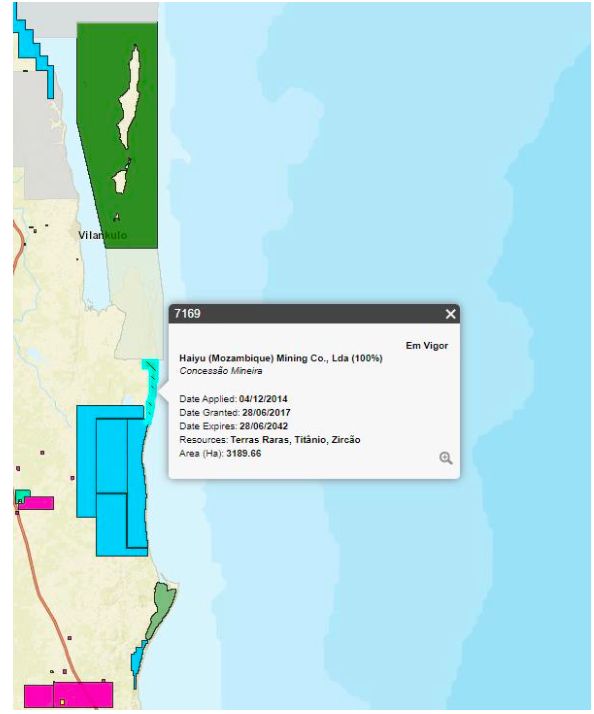
Documents and records obtained or consulted by CJIM pointed to a large-scale project, with long-term concessions, reserves estimated at tens of millions of tonnes, and investments valued at hundreds of millions of dollars.
Despite the economic scale of the undertaking, a central gap persisted: public transparency did not keep pace with the project’s scale. Who authorised the exploration? Under what conditions? Based on what studies? And under what oversight mechanisms?
The new configuration of concessions identified on the MIREME portal now adds another dimension to these questions, without, to date, an official explanation having been given as to what actually happened.
Vilankulo Previous Slashing
Vilankulo new land reclamation!
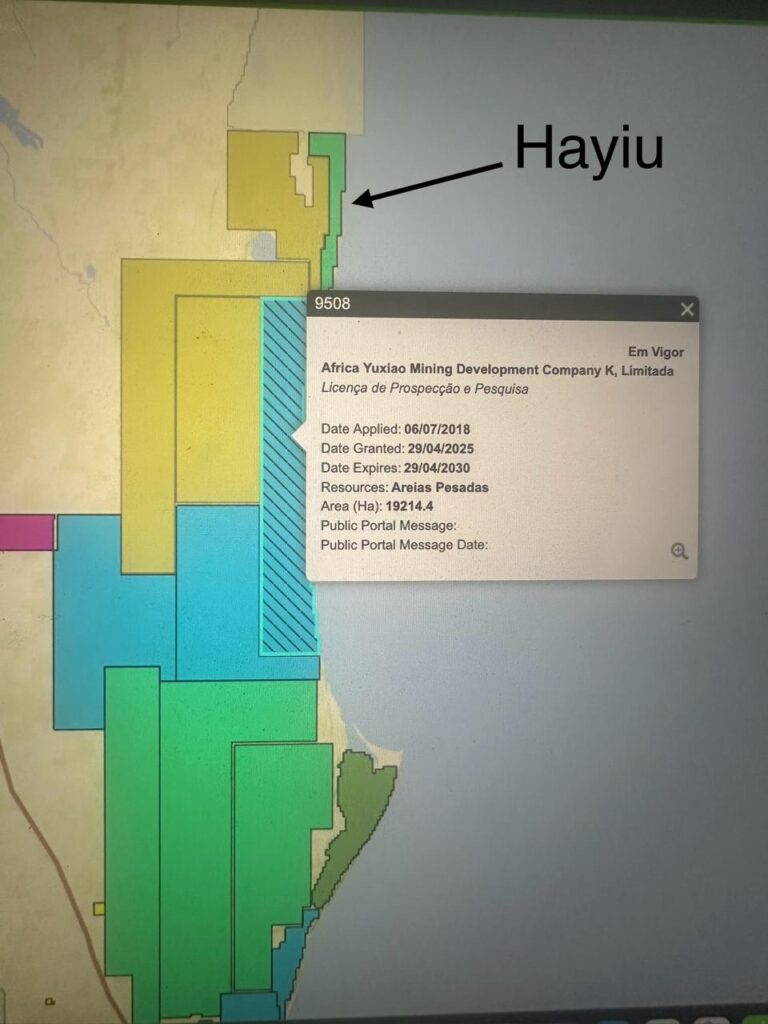
During a prior visit to the website of the Ministry of Mineral Resources and Energy (MIREME), CJIM observed a new fragmentation where one of the concessions previously granted to the Chinese mining company Hayui Mining, Ltd (Holding) of Great Wall Mining Investment recently passed into the ‘ control ‘ of (MIREME).
CJI in a letter requesting information sent to MIREME (Subject: Right to a response from the Minister of Mineral Resources and Energy (MIREME))
Maputo, November 6th
Based on Article 48 of the Constitution of the Republic of Mozambique , in conjunction with the Right to Information Law (Law No. 34/2014 ), we respectfully address Your Excellency with the aim of submitting the following request for information :
The Center for Investigative Journalism in Mozambique (CJIM) hereby requests answers from MIREME in the following context .
Subject: Hayui Mining Concession in Vilankulo-Inhambane
Case in question
In the concession granted to the Chinese mining company Hayui Mining, part of the Africa Wall Mining Investment, Ltd. group, the current concession map (Mining Registry) shows MIREME (Ministry of Mines and Energy) as the owner, unlike the previous one. Does this confirm the change in ownership, and what is the reason for it?
The company in question was suspended from its activities this year and fined nine million meticais. Why was the company fined, and who fined it? The Ministry has not yet bothered to answer.
Company suspended, workers compensated, and an uncertain future.
Meanwhile, ona brief return to Vilankulo more than two months ago, and more recently, on the week of November 26, 2026, the CJIM team contacted local sources again and confirmed that the company continues to have its activities suspended.
The situation remains undefined, both for the workers, some of whom are being compensated, and for the ecosystem itself, which remains exposed to the consequences of an operation whose oversight and future are uncertain.
“Everything is still silent here,” summarised one of the sources contacted by CJIM.
According to reports, most operations remain paralysed. Workers whose contracts are ending are not being rehired, while only some maintenance services continue to operate.
“They are not operating, and many people are being compensated. Those who terminate their contracts do not sign another. The only sector that is still functioning, for now, is the repair shops. The rest is at a standstill,” reported a source.
The same source, however, mentioned the presence of a team on site to drill a hole for the installation of a water pump, near an old workshop next to the park.
“Right now, there’s a team drilling a hole to install a water pump, right where our workshop used to be, almost next to the park. That’s what we’re seeing for now. We don’t know if there will be other activities. We don’t know anymore,” he added.
The situation also remains unclear regarding port infrastructure and the population that, directly or indirectly, depended on the project for income.
“Regarding the port, we still don’t have any information. The population is working again, but it’s not like before. We don’t know how things are now, because they are also compensating people. We don’t know if, when they resume activities, they will call this population back or not,” the source explained.
The scenario reveals a reality marked by uncertainty. On one hand, a company whose activity remains suspended, with workers being compensated and no clear indications of a possible resumption. On the other hand, concessions whose administrative configuration seems to have changed, but without the State having publicly explained the scope of this change.
The question remains unanswered: what will happen to Vilankulo?
The eventual departure of Haiyu, the reversal or reorganisation of concessions, and the possibility of a future resumption of exploration are not merely business or administrative issues.
They involve the fate of an environmental asset of national importance, the sustainability of a local economy heavily dependent on tourism, and the rights of the communities living in that region.
While MIREME (Ministry of Mineral Resources and Energy) does not clarify the new situation regarding mining titles, the official silence continues to fuel doubts about who effectively controls the concessions, who will be held accountable for the impacts already produced, and who will guarantee that the future of Vilankulo is not decided outside the public interest.
