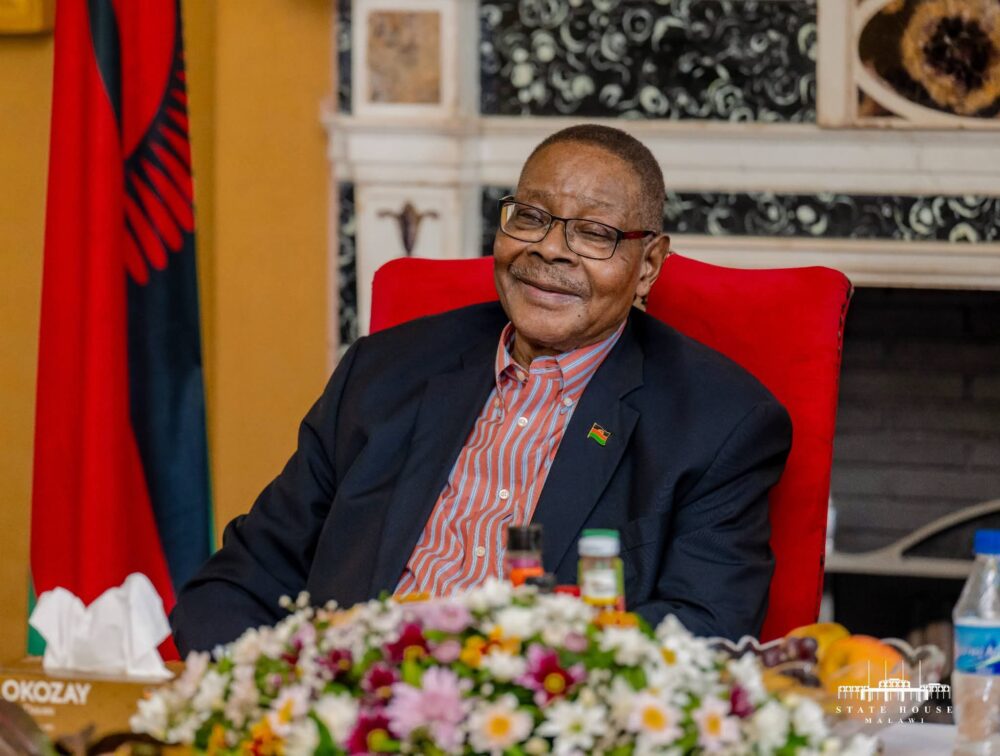
The president says he remained in charge during 25 days in South Africa. Public records show some decisions and official representation but leave questions about how executive authority was exercised and scrutinised.
By Collins Mtika
President Peter Mutharika’s 25-day stay in South Africa in October raises a constitutional question that goes beyond his physical absence: who exercised executive authority while he was away, under what powers, and how were those decisions scrutinised?
Malawi’s Constitution distinguishes between temporary presidential absence, incapacity and the delegation of presidential powers. Mutharika says he remained in control of government business, but he gave that assurance in an interview with his own press secretary rather than independent journalists.
Public records show that officials represented Malawi abroad and that at least one presidential instruction was issued during his absence. However, they do not provide a complete account of how executive decisions were made, who implemented them or under what authority.
The available evidence does not establish that anyone exercised presidential powers without authority. It does, however, expose a broader question about transparency and constitutional oversight when a president governs from outside the country.
What the two terms show
The comparison covers the first 411 elapsed days of each presidency: May 31, 2014, to July 16, 2015, and Oct. 4, 2025, to Nov. 19, 2026. It focuses on documented appearances and representation at selected events rather than every presidential engagement.
During his first term, Mutharika addressed the United Nations General Assembly in New York on Sept. 25, 2014. He also opened a budget meeting of Parliament in May 2015. In his second term, Foreign Minister George Chaponda delivered Malawi’s address at the United Nations on Sept. 28, 2026.
However, Mutharika personally delivered the State of the Nation Address in Parliament on Feb. 13, 2026, opening that year’s budget meeting, according to Parliament’s records. Although other officials represented Malawi at major international meetings, Mutharika still opened the domestic budget debate.
The Durban summit cannot be directly compared with the Victoria Falls meeting. Mutharika was handing over two different SADC positions, and several other member states also sent representatives in 2026.
The Durban communiqué called on governments to remove barriers to agricultural trade and improve cross-border logistics.
For landlocked Malawi, participation in discussions about moving goods across borders matters, regardless of who attends. However, while the communiqué identifies Malawi’s representative, it does not show whether that choice affected the summit’s outcomes.
Mutharika’s first presidency was not always marked by public visibility. In October 2016, outside the comparison period, he returned from a roughly monthlong visit to the United States. The trip began with an appearance at the United Nations, but his extended absence raised questions, as contemporary reports recorded.
What distinguishes his current term is the frequency of his trips.
Malawi24 documented five private visits to South Africa between December 2025 and October 2026. Calculating the time between each departure and return gives a combined 77 days abroad.
That figure represents time spent away from Malawi, not days when Mutharika was necessarily off duty. Travel records alone cannot establish who made government decisions during those periods.
Who exercises presidential authority?
Malawi’s Constitution distinguishes between a president’s temporary absence and incapacity. Section 92(3) allows First Vice President Jane Ansah to preside over Cabinet meetings when the president is temporarily absent. Under Section 87, she would act as president if Mutharika were formally declared incapacitated and unable to perform his duties.
However, that provision requires a specific declaration and certification process. Travelling abroad does not automatically trigger it.
Section 89(6) allows the president to delegate powers in writing to a Cabinet member or government official. Section 90(1), meanwhile, requires presidential decisions to be expressed in writing under the president’s signature.
Malawi Law Society President Davis Njobvu told The Nation that the Constitution does not limit how long a president may remain outside the country.
The number of telephone calls Mutharika made does not, by itself, establish what decisions were taken. His account identifies officials he consulted, including Saidi, but does not explain what instructions he issued, who implemented them or under what authority they acted.
Similarly, a minister representing Malawi at an international meeting does not necessarily mean that general executive authority has been transferred.
During Mutharika’s October trip, the trade minister led Malawi’s delegation to a regional summit in Zimbabwe. This identified the official responsible for that particular engagement, not someone acting as president.

The way State House handled Mutharika’s return also limited opportunities for independent scrutiny. He answered questions from Maulidi in a government-released interview rather than facing independent journalists who could ask follow-up questions.
Information Minister Shadric Namalomba said the trip was private and had not created a leadership vacuum. While a private journey may justify withholding personal details, it does not settle the question of what information should be made public about the exercise of presidential powers.
In an interview with The Nation, Media Council of Malawi chair Jolly Ntaba said restricting access to the state broadcaster did not amount to engagement with the wider media, including private and community outlets.
What the public could not test
An Oct. 23 letter attributed to Mutharika instructed Speaker of Parliament Sameer Suleman to postpone a midyear budget review scheduled to begin on Nov. 9 until the next budget meeting. The letter cited the need to redirect resources towards addressing fuel shortages and preparing for anticipated El Niño conditions.
Suleman announced the postponement. As a result, lawmakers lost an immediate opportunity to examine public spending and consider adjustments to the national budget.
The Malawi Law Society challenged the interpretation of the speaker’s responsibilities.
It argued that Section 59(1) of the Constitution gives the speaker a role in scheduling parliamentary meetings in consultation with the president. It does not, the society argued, require the speaker to comply with a presidential instruction to postpone an already agreed sitting.
Attorney General Frank Mbeta defended the decision. He said the president had a role in setting parliamentary dates and could take the fuel crisis and preparations for El Niño into account.
These remain competing legal interpretations rather than conclusions reached by a court. Although parliamentary committees could continue their work, the scheduled midyear budget review did not take place.
The postponement reduced the opportunity for immediate scrutiny of public spending.
It also provides an example of an instruction publicly attributed to Mutharika that had a practical effect while he was abroad. However, the letter does not establish who handled other presidential decisions during that period.
Mutharika’s first term provides a different example of how executive responsibilities were publicly demonstrated during a national emergency.
In January 2015, he declared flood-affected districts disaster areas and visited hard-hit Mangochi. At the same time, Vice President Saulos Chilima publicly reported casualty figures, according to disaster assessments and Anadolu Agency.
The 2015 floods and the October 2026 fuel shortage were different emergencies. These examples show which officials’ actions were publicly identifiable during each crisis. They do not establish whether one administration managed an emergency better than the other.
During the October fuel shortage, motorcycle taxi operator McDonald Kachule told Africanews that he was spending more time waiting for fuel than working.
The World Bank had already identified foreign-exchange shortages as a constraint on economic activity. However, the timing of the fuel queues does not prove that presidential travel caused the shortages.
After returning, Mutharika attributed the fuel shortage to logistical problems.
On Nov. 17, Namalomba said the Ministry of Finance had released US$30 million for fuel procurement. However, he could not provide a firm date for when the crisis would end, Malawi24 reported.
For drivers and businesses trying to plan their activities, the immediate questions remained: When would fuel supplies arrive, and which officials were responsible for ensuring delivery?
Public ceremonies provide another important distinction. On Nov. 8, after Mutharika had returned, Cabinet minister Alfred Gangata led the Remembrance Day service in Lilongwe on the president’s behalf. This was a ceremonial substitution, not evidence that presidential powers had been transferred.
On Nov. 19, Malawi24 reported that social media influencer Pemphero Mphande had called on Mutharika to address fuel and foreign-exchange shortages.
Representing the president at a wreath-laying ceremony is different from explaining government policy and responding to public concerns. A new timetable for the postponed budget review would help clarify when Parliament can resume its scrutiny of public spending.
Such information could also help distinguish decisions Mutharika personally made while abroad from work carried out by ministers under their own authority or through delegated powers.
Until then, questions remain about the extent to which others exercised presidential authority beyond the specific actions documented in public records.
