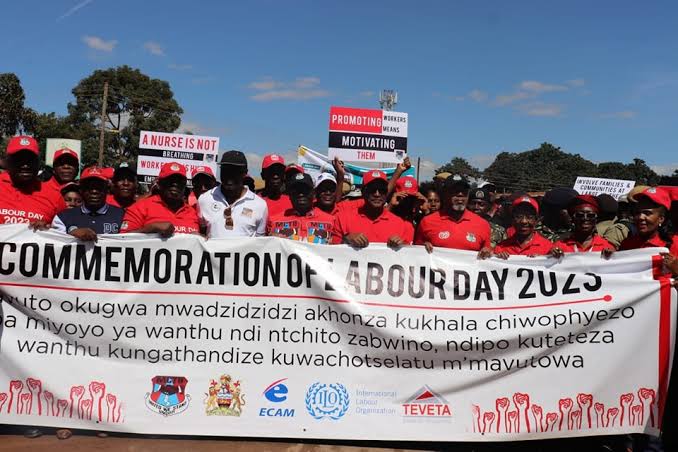
Global rights data show severe labour-rights underperformance while key political-rights indicators remain unmeasured.
By Collins Mtika
Malawi is recording one of its weakest performances on a major international measure of economic rights, yet a significant gap in global human rights monitoring means key aspects of the country’s civil and political rights remain unmeasured.
According to the Human Rights Measurement Initiative’s (HRMI) 2026 Rights Tracker, Malawi scored 17 per cent on the right to work when assessed against what is achievable at its income level and 10.9 per cent when measured against the world’s best-performing countries.
The findings place work rights at the bottom of all five quality-of-life indicators assessed for Malawi and raise questions about how the country’s human rights performance is being monitored and scrutinised.
The figures are notable because HRMI’s methodology adjusts expectations according to national income.
Malawi, one of the world’s poorest countries, is therefore assessed against outcomes considered achievable with its available resources rather than against wealthier states.
Despite the severity of the findings, there is little evidence that the right-to-work score has become a central focus of formal accountability processes involving government institutions, parliament, development partners, or international donors.
HRMI’s Rights Tracker produces country-level assessments of economic and social rights by comparing outcomes against what countries could reasonably achieve given their per capita income.
For Malawi, the 2026 dataset shows substantial variation across sectors. Health recorded the country’s strongest performance, scoring 98.4 per cent against the income-adjusted benchmark.
Food scored 82 per cent and education 76.1 per cent, while housing achieved 63.8 per cent. Work rights ranked lowest by a wide margin.
The labour market data underpinning that assessment align with broader indicators of economic strain.
The Danish Trade Union Development Agency’s 2026 Labour Market Profile for Malawi reports that 39 percent of young people aged 15 to 24 are not in education, employment, or training.
Official unemployment estimates reached 15 per cent in 2024, although the report notes that this figure may not fully capture underemployment, seasonal work, and subsistence livelihoods that characterise much of Malawi’s labour market.
More than 90 percent of employment is located within the informal economy, where workers often operate beyond the reach of formal labour protections, social security systems, and collective bargaining structures.
The country’s labour challenges sit within a broader economic context.
The World Bank’s October 2025 Malawi Poverty and Equity Brief estimated that 76.6 per cent of Malawians would be living on less than three US dollars per day in 2025, with a further 482,000 people expected to fall into poverty during the year.
GDP per capita stood at US$508 in 2024, among the lowest levels globally.
Recent economic growth averaged 2.2 percent, significantly below the 10.6 percent annual growth rate the World Bank has estimated would be required for Malawi to attain lower-middle-income status by 2030, a key objective of the government’s Malawi 2063 development strategy.
The DTDA Labour Market Profile also reports that population growth of 2.6 per cent has exceeded economic growth in recent years, contributing to declines in real GDP per capita.
Inflation has remained above 30 per cent in recent reporting periods, reducing purchasing power and placing additional pressure on households.
Climate-related shocks, including Cyclone Freddy in 2023 and subsequent dry spells, have further affected livelihoods in a country where approximately 82 percent of the population lives in rural areas.
The evidence supporting Malawi’s economic and social rights assessments is extensive and publicly accessible.
HRMI draws on data from institutions including the World Health Organization, UNICEF, the International Labour Organization, and the World Bank. The DTDA profile relies on ILOSTAT, World Bank datasets, and national statistical sources.
The World Bank Poverty and Equity Brief uses official economic and survey data. However, the same monitoring framework highlights a significant limitation.
HRMI’s 2026 dataset does not provide civil and political rights scores for Malawi. As a result, the country has no HRMI assessment covering areas such as freedom of expression, freedom of association, freedom from arbitrary arrest, or political participation.
The absence of these indicators means that a widely used international framework for measuring human rights performance currently provides only a partial picture of Malawi’s overall rights environment.
Neither HRMI’s dataset nor publicly available materials reviewed for this article indicate when civil and political rights data for Malawi will become available.
Alternative accountability mechanisms exist, but they operate differently.
In April 2026, a national validation workshop in Lilongwe reviewed Malawi’s state-party report to the United Nations Human Rights Committee under the International Covenant on Civil and Political Rights (ICCPR).
However, that process produces qualitative assessments rather than the benchmarked quantitative indicators used by HRMI.
The result is that policymakers, donors, researchers, parliamentarians, and civil society organisations have access to systematic numerical measures of economic and social rights, but not equivalent data for civil and political rights within the same framework.
The consequences of poor work-rights outcomes are particularly evident among young people.
With 39 percent of youth outside education, employment, or training and trade union density standing at just 3.3 percent of total employment, many young workers enter the labour market with limited access to formal protections.
Social protection coverage extends to only 20 percent of the population, leaving many households vulnerable to economic shocks.
Women face additional challenges. More than 90 percent of women are employed informally, primarily in subsistence agriculture and small-scale trade.
The Malawi Human Rights Commission’s 2025 Universal Periodic Review submission documented 65 workplace sexual-harassment cases handled between 2021 and 2024.
The commission also conducted a public inquiry into sex-for-fish practices in Nkhotakota, highlighting concerns about the relationship between economic vulnerability and exploitation.
The commission further noted that Malawi has yet to ratify International Labour Organization Convention 190 on Violence and Harassment in the Workplace.
These outcomes contrast with Malawi’s extensive record of international commitments.
The country has ratified all ten ILO Fundamental Conventions and three of the organisation’s four Governance Conventions. Malawi is also a signatory to the Abuja Declaration, under which African governments committed to allocate at least 15 percent of national budgets to health.
Health spending reached 12.2 percent of the national budget during the 2024/25 fiscal year, the highest level recorded, but remained below the Abuja target. The proposed allocation for 2026/27 fell to 9.2 percent while debt servicing accounted for 27 percent of planned expenditure.
The contrast between formal commitments and measured outcomes is particularly evident in labour rights.
Malawi can participate in international review mechanisms, ratify conventions, and adopt long-term development strategies while still recording a right-to-work score of 17 percent against income-adjusted benchmarks.
The available evidence suggests that commitments alone do not necessarily translate into improved outcomes. The issue received little visibility during Malawi’s most recent Universal Periodic Review process.
At the 50th session of the Universal Periodic Review in November 2025, Malawi received 294 recommendations and supported 228 of them. Recommendations included measures aimed at strengthening civic space and accountability mechanisms.
However, the review outcomes did not reference the HRMI right-to-work score or establish a mechanism for linking qualitative recommendations to quantified rights outcomes.
This matters because international development financing and policy decisions often rely on assessments of governance and human rights performance.
If economic rights indicators reveal severe shortcomings while civil and political rights remain unmeasured within the same framework, decision-makers are operating with an incomplete picture of national performance.
The implications extend beyond labour rights alone.
Civil society submissions to Parliament reported that United States funding to Malawi fell by an estimated US$62 million between 2024 and 2025, contributing to documented gaps in HIV, tuberculosis, maternal-health, and child-health services.
Those pressures affect a health sector that currently records Malawi’s strongest HRMI performance, raising questions about the sustainability of gains achieved through previous investment.
Regional initiatives may offer opportunities for labour mobility. The Southern African Development Community Employment and Labour Protocol, signed in 2023, and visa-free movement arrangements under the Common Market for Eastern and Southern Africa aim to facilitate regional economic participation.
But with more than 90 percent of workers employed informally and documented skills mismatches across vocational training systems, access to those opportunities remains limited for many Malawians.
For now, Malawi’s position within international rights monitoring frameworks remains incomplete.
The country records one of its weakest scores on the right to work, faces persistent youth disconnection from education and employment, and continues to confront rising poverty pressures.
At the same time, no equivalent HRMI assessment exists for civil and political rights.
