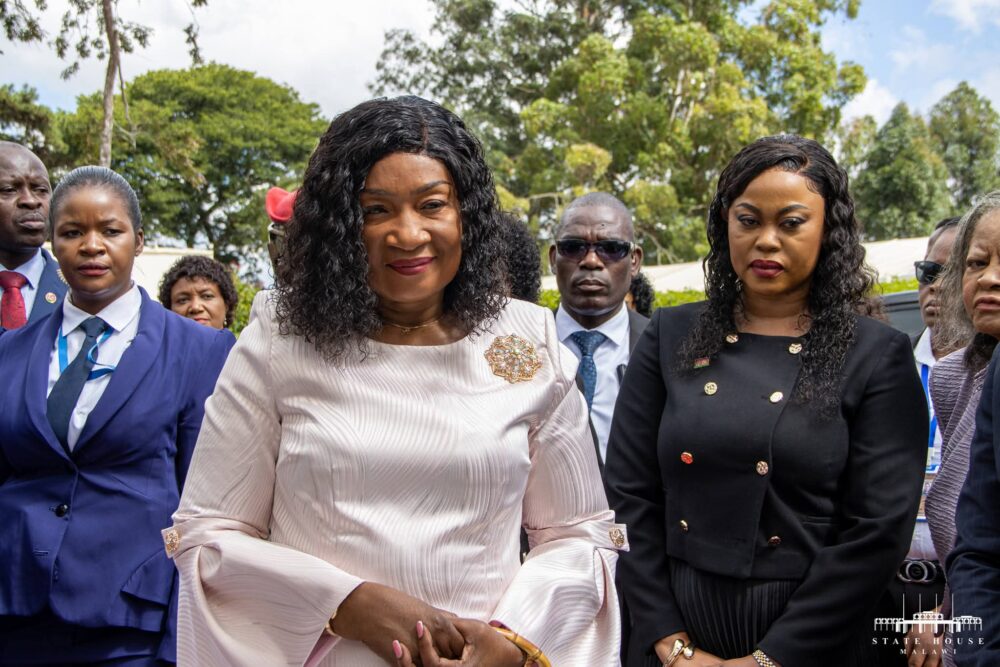
Contributions from controversial regional figures revive scrutiny over governance and political influence
By Collins Mtika
A charity chaired by Malawi’s first lady has accepted multimillion-dollar pledges from two men facing serious legal proceedings in South Africa, relaunched from the presidential residence, and resumed high-profile public activity.
It has done so without providing publicly available audited accounts or confirmed proof of registration under Malawi’s updated non-profit regulatory framework.
The Beautify Malawi Trust, led by first lady Gertrude Mutharika, held a relaunch ceremony at Kamuzu Palace, the presidential residence in Lilongwe, in February 2026, attended by President Peter Mutharika and senior government and ruling party officials.
Within three months, the trust had received a one-million-dollar pledge from Zimbabwean businessman Wicknell Chivayo and a 300-million-kwacha donation from Malawian-born preacher Shepherd Bushiri and his wife.
Both men are subject to significant legal and financial scrutiny in South Africa. Neither donation has been accompanied by public disclosure of how the trust manages or accounts for the funds it receives.
The trust’s governance gaps are not new. In 2014, an unauthorised transfer of public health funds to the organisation contributed to Malawi losing its status as principal recipient of a 574-million-dollar grant from the Global Fund to Fight AIDS, Tuberculosis and Malaria, with documented consequences for HIV and tuberculosis service delivery.
That pattern has re-emerged at a particularly sensitive moment. Malawi’s public debt stood at approximately 90.9 per cent of gross domestic product at the end of 2025; the World Bank has classified the country as being in debt distress, and an International Monetary Fund programme collapsed in May of that year.
The governance conduct of institutions linked to the presidency carries direct weight with the international partners on whom Malawi depends for financial support.
The Beautify Malawi Trust first appeared during President Mutharika’s earlier term in office, presenting itself as a citizen-driven initiative to promote public hygiene and environmental care.
Official statements at the time announced that a trust had been registered in the first lady’s honour, and local media treated the organisation largely as a ceremonial project.
The trust received little sustained scrutiny before Mutharika lost the presidency in 2020, following a court-ordered rerun of the disputed 2019 election. The trust subsequently withdrew from public view then. Its website went offline, its social media accounts fell silent and no public accounting was made of what happened to its assets or resources.
Mutharika has since returned to the presidency.
In February 2026, the trust marked its relaunch with a five-year strategy covering the period 2026 to 2030, announced at Kamuzu Palace before an audience that included the president and members of the ruling party.
Government communication channels described it as a non-profit initiative, highlighting its renewed focus on sanitation and civic pride and positioning it as a partner of state institutions in service delivery. No audited accounts were released at the event, and no public confirmation of compliance with current non-profit regulations accompanied the announcement.
During the February 2026 ceremony, Wicknell Chivayo pledged one million dollars to the trust, according to an announcement by the organisation and contemporaneous local news coverage. Chivayo is a Zimbabwean businessman whose financial affairs have attracted scrutiny across the region.
An analysis by South Africa’s Financial Intelligence Centre found that more than 800 million rand flowed into companies associated with him after Zimbabwe’s finance ministry paid over 1.1 billion rand to a firm linked to him for election-related contracts.
In April 2026, the Pretoria High Court reinstated an order freezing his assets in South Africa, as part of a continuing legal process that has not reached final judgement. Chivayo has denied wrongdoing and stated that his engagements in Malawi concern potential investments.
His pledge to the Beautify Malawi Trust nonetheless connects a politically sensitive businessman already under financial crime scrutiny to a charity chaired by a sitting first lady.
Three months later, Shepherd Bushiri and his wife presented 300 million kwacha to the trust at a public ceremony at Kamuzu Palace in May 2026. The first lady stated that the funds would support sanitation programmes.
Bushiri is a Malawian-born religious leader who fled South Africa in 2020 while on bail over fraud and money-laundering charges linked to approximately 102 million rand.
A Malawian court ordered his extradition to South Africa in March 2025, but that ruling was later overturned on procedural grounds. South African authorities have signalled their intention to continue seeking his return.
Bushiri’s repeated appearances with senior Malawian officials have strained bilateral relations. South African media and officials have questioned how a fugitive from their courts is able to maintain high-level public engagements in Malawi.
His donation to a charity chaired by the first lady extends that tension into the domain of organised philanthropy, placing it visibly within the orbit of the presidency.
Concerns about the trust’s financial governance first emerged in late 2014, when the National AIDS Commission, a publicly funded body responsible for managing HIV resources in Malawi, transferred five million kwacha to the Beautify Malawi Trust without authorisation from its board.
The payment provoked civil society protests in Blantyre, Lilongwe and Mzuzu. Meeting minutes subsequently showed that the commission’s board had not been informed of the transaction, and the episode was linked to disciplinary proceedings against the executive director. The board resolved not to impose sanctions on the trust itself.
The consequences extended well beyond Malawi’s internal governance processes. The Global Fund to Fight AIDS, Tuberculosis and Malaria later removed the National AIDS Commission as principal recipient of a 574-million-dollar health grant, citing concerns over financial management that included the unauthorised transfer to Beautify Malawi.
Although services were eventually reorganised through other channels, the disruption affected the delivery of HIV and tuberculosis programmes. The episode established a clear precedent.
A charity linked to the first lady that received public funds without proper authorisation was capable of generating reputational damage with consequences far beyond its own activities.
Since 2020, Malawi has strengthened its non-profit regulatory framework. The NGO Regulatory Authority now requires organisations to register, submit annual reports and provide audited accounts. These requirements are designed to reassure both domestic citizens and international donors that funds earmarked for communities are properly managed.
Nation newspaper journalists reported in 2021 that there was no verifiable confirmation that Beautify Malawi was registered with the NGO regulator or listed with the Council for Non-Governmental Organisations in Malawi, though earlier press statements had referred to registration as a trust.
Since the trust’s relaunch, independent journalists and civil society monitors have unable to obtain audited accounts or confirm that the organisation appears on current NGO Regulatory Authority registration lists.
The trust’s legal status as a trust rather than a registered NGO may place it in a different regulatory category, but this distinction has not been publicly explained by either the organisation or the relevant authorities.
Requests for clarification sent to the trust’s spokesperson were forwarded to its chairperson and remained unanswered for almost two weeks at the time of publication.
At the February 2026 relaunch, President Mutharika told attendees that strong governance in charities was essential for attracting development partners and building public trust.
There is no public record of formal regulatory action against the Beautify Malawi Trust, despite the 2014 funding controversy and the current absence of published accounts.
