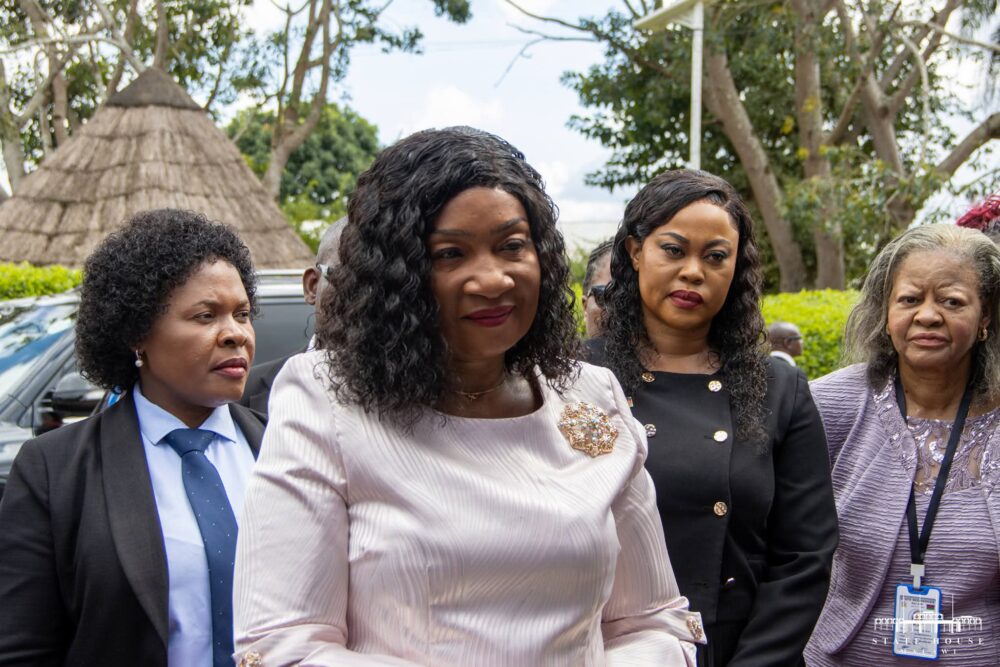
The first lady’s charity collects millions from figures under criminal investigation across the region as Malawi negotiates its most acute fiscal crisis in a generation.
By CIJM
When Malawi’s Beautify Malawi Trust (BEAM) relaunched its five-year strategic plan in February 2026, the ceremony at Kamuzu Palace carried the unmistakable weight of official endorsement.
President Peter Mutharika attended in person.
NBS Bank formalised a K5 billion commitment. Within days, a Zimbabwean businessman named in a multi-billion-dollar state corruption dossier pledged US$1 million to the trust, which is chaired by the president’s wife.
That sequence of events, compressed into a single week, frames the central question: whether the Beautify Malawi (BEAM) Trust, founded and chaired by First Lady Professor Gertrude Mutharika, is operating with the governance standards that Malawi’s own president, speaking at that very ceremony, described as “essential to build public trust and attract development partners”.
BEAM Trust was established in 2014, shortly after Peter Mutharika’s first election victory.
Operating on a mandate of sanitation and environmental education, it collected donated trucks, awarded scholarships, and ran awareness campaigns funded by city councils, private sponsors, and government-aligned entities.
The University of Malawi awarded Gertrude Mutharika an honorary doctorate in 2016 in recognition of her environmental mobilisation efforts.
The Trust’s first institutional controversy emerged almost immediately. In late 2014, K5 million from the National AIDS Commission was transferred to BEAM without board authorisation.
Civil society organisations mounted demonstrations in Blantyre, Lilongwe, and Mzuzu. The funds were eventually returned through an arrangement involving unnamed “well-wishers” and the government’s Chief Secretary. The NAC executive director faced a disciplinary process; BEAM faced none.
In subsequent months, the Global Fund replaced NAC as a principal recipient of a US$574 million grant, with investigators citing NAC’s financial management failures, of which the BEAM transaction formed a part, as a contributing factor.
When Mutharika lost power in 2020, following a constitutional court ruling that annulled the contested 2019 election, BEAM’s website went offline, its social media presence went dark, and its vehicles disappeared from city streets. No formal wind-down process entered the public record. The Trust’s assets were never publicly accounted for.
BEAM’s February 2026 revival followed Mutharika’s return to power in September 2025, when he secured approximately 66 per cent of counted votes amid widespread public frustration with the economic record of his predecessor, Lazarus Chakwera.
Wicknell Chivhayo, a Zimbabwean businessman, pledged US$1 million to BEAM on 25 February 2026, one day before the Trust’s strategic plan launch. Chivhayo confirmed that his presence in Malawi was connected to efforts to secure an emergency fuel supply contract, a matter of acute national urgency.
Malawi had endured persistent fuel shortages for the better part of two years. In April 2026, the government sold gold from its international reserves and sought a US$120 million loan from Afreximbank to finance fuel deliveries.
Chivhayo’s commercial and legal record merits close scrutiny. His flagship Gwanda Solar facility in Zimbabwe, valued at US$173 million, has faced repeated delays.
A South African Financial Intelligence Centre report linked him to more than R800 million in transfers to his companies following a R1.1 billion payment from Zimbabwe’s Ministry of Finance to a supplier of election materials.
A corruption dossier, reportedly compiled for consideration by the ZANU-PF Politburo and subsequently leaked, named Chivhayo among businessmen alleged to have participated in the diversion of more than US$3.2 billion in Zimbabwean state funds.
South Africa’s Directorate for Priority Crime Investigation confirmed in January 2026 that enquiries into his financial dealings remained active, contradicting public claims that the matter had been closed. He has denied all wrongdoing.
Shepherd Bushiri, the Malawian-born leader of the Enlightened Christian Gathering church, donated K300 million to BEAM at a cheque handover ceremony at Kamuzu Palace on 13 May 2026. First Lady Mutharika described the contribution as a “major boost” to the Trust’s sanitation programme.
Bushiri and his wife Mary fled South Africa in November 2020 while on bail for fraud and money laundering charges involving approximately 102 million rand. A Malawian magistrate’s court ordered their extradition in March 2025. That ruling was overturned by the High Court in October 2025 on procedural grounds.
South Africa has stated it will continue pursuing the matter. Each public ceremony at which Bushiri appears alongside Malawian officials adds diplomatic friction to a case already generating tension between Pretoria and Lilongwe.
BEAM Trust’s legal registration, governance structure, and auditing arrangements are not consistently documented in any publicly accessible record. As Malawi’s Nation newspaper noted in 2021, no publicly verifiable confirmation had emerged that BEAM was registered with the country’s NGO Board or that it held a formal constitution.
No annual financial reports appear to have been published in any form accessible to civil society. That gap remains unresolved. BEAM Trust did not respond to requests for comment for this report.
The governance questions surrounding BEAM arise in the context of Malawi’s most severe fiscal crisis in recent memory. A Reuters report in early 2026 placed the country’s public debt at approximately 23.9 trillion kwacha, equivalent to roughly US$13.9 billion and representing close to 90 per cent of GDP.
The IMF’s four-year, US$175 million Extended Credit Facility lapsed in May 2025 with only US$35 million disbursed, after Malawi failed to complete required programme reviews. Negotiations over a replacement facility are ongoing.
The World Bank’s February 2026 Malawi Economic Monitor called for coordinated action to restore macroeconomic stability and strengthen institutional frameworks, concluding that the country’s capacity to attract concessional financing depends not only on budget performance but also on the credibility of its governance environment.
A first lady’s charity that collects seven-figure pledges from figures under criminal investigation in neighbouring countries and from a fugitive from regional justice, operating without any publicly verified disclosure framework, sends governance signals that complicate precisely the reform argument the new administration needs to make credibly to international lenders.
The internal contradiction is made visible by the president’s own words.
Speaking at BEAM’s February relaunch, Mutharika called NGO transparency “essential to build public trust”.
BEAM, operating as a first-family foundation with no published accounts, will need to demonstrate that the standard applies to the organisation positioned closest to executive power.
