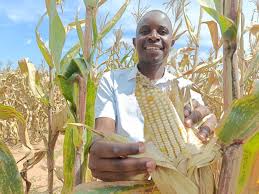
Malawi embraced genetically modified cotton, but maize, the country’s staple food, remains politically untouchable. This is the story of how caution, contradiction, and crisis intersect.
Malawi is facing one of its worst food crises in years. Millions of people are struggling to secure enough to eat as maize harvests fall, prices soar, and an invasive pest spreads across the country.
Still, even as pressure mounts, the government has ruled out the use of genetically modified maize, one of the tools scientists say could help contain the damage.
In the parched fields of southern Malawi, maize plants stand stunted and shredded by the fall armyworm, an invasive pest that governments across Africa have been racing to control since it arrived on the continent about a decade ago.
If left unchecked, the caterpillar can wipe out an entire maize crop in a matter of weeks. Highly adaptive and difficult to control, it has destroyed up to 100 per cent of yields in some fields.
During the 2023/24 growing season, the pest infested an estimated 14 per cent of Malawi’s planted maize area, according to agriculture sector assessments, raising fears of deeper losses ahead.
Those losses are already translating into hunger.
Between January and March 2026, an estimated two to two-and-a-half million Malawians are projected to require humanitarian food assistance, according to current food security forecasts.
Other assessments warn that the number of people facing crisis-level food insecurity could rise to as many as four million if conditions continue to deteriorate.
Maize prices have climbed to roughly 200 per cent above their five-year average, effectively putting the country’s staple food beyond the reach of many low-income households.
The 2024/25 maize harvest fell 22 percent below the five-year average, with some southern districts recording production declines of up to 75 percent.
Even as fields fail, scientists say viable options exist to reduce losses.
At Lilongwe University of Agriculture and Natural Resources (LUANAR), researchers have conducted confined field trials of genetically modified maize engineered to resist fall armyworm.
Carried out under Malawi’s biosafety regulations, the trials show a stark contrast: Bt maize plants remain largely intact, while neighbouring conventional varieties suffer extensive pest damage.
Despite these results, Malawi has yet to approve genetically modified maize for commercial cultivation.
In October 2024, then agriculture minister Sam Kawale publicly ruled out GM crops as a response to the country’s food challenges, citing concerns about human health.
“It is noted that even countries with advanced GMO research have backtracked due to health concerns,” Kawale said at the time. “Instead, let us all advocate for hazard-free technologies like organic products to alleviate hunger.”
That assertion is not supported by available evidence.
Countries with advanced biotechnology sectors have continued to approve and use genetically modified crops under regulatory oversight. The European Union regulates GM crops on a case-by-case basis and permits several for animal feed.
The United States has approved more than 200 genetically modified crop events, while Argentina, Brazil, and Canada have widely integrated GM crops into commercial agriculture.
International scientific bodies have repeatedly found no evidence that approved GM foods pose unique health risks.
In 2016, the U.S. National Academy of Sciences reviewed more than 1,000 studies and reported no persuasive evidence of adverse health effects directly linked to the consumption of genetically engineered foods.
The World Health Organization has similarly stated that GM foods currently on the international market have passed safety assessments and are unlikely to present risks to human health.
Surveys of scientists reflect that consensus.
A 2015 Pew Research Center survey of members of the American Association for the Advancement of Science found that 88 percent considered GM foods safe to eat. More than 275 science and health organisations worldwide have issued statements supporting the safety of approved GM crops.
Malawi itself has a legal framework designed to manage such risks. The country adopted biosafety legislation more than two decades ago, establishing procedures for research, testing, and approval of genetically modified organisms under controlled conditions.
The gap between policy and practice is particularly evident in one sector of Malawian agriculture.
Cotton’s quiet revolution
In 2020, Malawi approved Bt cotton, a genetically modified variety engineered to resist the African bollworm, for commercial cultivation. The pest had long plagued cotton farmers, forcing many to spray pesticides repeatedly during the growing season.
Cotton accounts for a disproportionate share of pesticide use in Africa, exposing farmers and farm workers to hazardous chemicals. Bt cotton altered that pattern by producing a protein toxic to the bollworm, sharply reducing the need for routine spraying.
In Salima District, near Lake Malawi, farmers say the impact has been immediate.
Amani Kafa, 31, began planting Bt cotton in 2020. On the same two acres, his output more than doubled, from about 50 bales per season to between 100 and 150. The higher income allowed him to buy land, build a house, and purchase a car.
Ackim Livinala, a long-time cotton farmer, saw yields rise from four to eight bales per acre after switching to Bt seed. On three acres, he harvested 34 bales in a recent season, compared with just seven bales on four acres planted with conventional varieties.
Pesticide use also fell sharply. Kafa now sprays about three times per season instead of twelve.
Livinala reduced spraying from weekly applications to roughly twice a month. Studies from other countries suggest such reductions can have measurable health benefits.
Peer-reviewed research on Bt cotton adoption in Pakistan estimated annual savings of about $7 million from reduced pesticide-related illness.
The technology has been widely adopted. More than 95 percent of Malawi’s cotton farmers now plant Bt varieties, according to agriculture officials, an uptake that reflects strong farmer confidence.
The maize gap
That experience has not been replicated in maize, Malawi’s most important food crop.
Unlike cotton, maize sits at the centre of national politics and household survival. Proposals to alter how it is grown tend to trigger broader anxieties about food sovereignty, dependence on foreign seed companies, and the erosion of traditional farming systems.
Those concerns are not without foundation. Questions around seed pricing, farmer choice, and market concentration remain central to debates over agricultural biotechnology.
But they also obscure a more immediate problem: existing approaches are struggling to keep pace with the fall armyworm.
First detected in Africa in 2016, the pest has few natural enemies on the continent.
Chemical control is costly and often out of reach for smallholder farmers, while repeated spraying accelerates environmental damage and resistance. Conventional breeding has produced maize varieties with partial resistance, but developing and scaling them takes years.
The International Maize and Wheat Improvement Center (CIMMYT) has released fall armyworm-tolerant hybrids developed through conventional breeding, relying on native genetic resistance.
These varieties have helped reduce losses, but researchers acknowledge their limits under heavy infestation.
Transgenic maize varieties designed specifically to target the pest remain under development or in trial phases in several African countries, including Kenya, Zambia, Malawi, Ghana, and South Sudan.
From a technical standpoint, scientists say Malawi has the capacity to evaluate such crops.
The capacity question
Malawi’s biosafety system is well established on paper. Laws and policies adopted since the early 2000s outline procedures for risk assessment, confined field trials, and regulatory approval.
Genome-editing guidelines issued in 2022 further clarified how emerging technologies should be assessed.
In practice, implementation has lagged.
Regulatory committees operate with limited funding and staff. Food and feed safety guidelines under discussion since 2019 remain incomplete. Approval processes are slow, and responsibilities are spread across multiple agencies, creating delays and uncertainty.
Similar challenges exist across the Southern African Development Community, where regulatory systems have often struggled to keep pace with scientific advances.
In Malawi’s case, however, the bottleneck has increasingly become political, with senior officials signalling reluctance to move beyond trials despite the existing legal framework.
International development partners working in Malawi, including the World Bank, the Food and Agriculture Organization, CGIAR centres, and the African Agricultural Technology Foundation, have consistently supported biotechnology as one component of broader efforts to improve food security and climate resilience.
The cost of caution
Debate over agricultural biotechnology is legitimate. Decisions about pace, regulation, and equity carry real consequences. But those debates are unfolding against a backdrop of rising hunger, volatile weather, and shrinking harvests.
Bt cotton’s performance in Malawi offers one domestic reference point.
Decades of global consumption of approved genetically modified crops have not produced verified evidence of harm attributable to the genetic modification itself, according to international scientific reviews. Regulatory systems exist to assess risks and manage uncertainty.
The fall armyworm, meanwhile, continues to spread regardless of policy hesitation.
For farmers already grappling with erratic rains and rising input costs, the stakes are immediate.
As Professor Abel Sefasi, a molecular biologist and senior lecturer at LUANAR, has argued, biotechnology offers a critical option for addressing some of Malawi’s most persistent agricultural challenges.
He cautions that it is not a cure-all. GM crops, he says, must be integrated into broader climate-smart strategies that include soil management, crop diversification, and farmer education.
The decision facing Malawi’s policymakers is therefore not simply about technology.
It is about whether existing scientific tools, regulatory systems, and lessons from within the country itself will be used to respond to a deepening food crisis, or left on the shelf as millions of people face another hungry season.
