
While the Reserve Bank tightens controls on commercial banks to mobilise foreign exchange, a gaping hole in mining revenues suggests the real leak lies far beyond the reach of the new Foreign Exchange Act.
Inside the polished boardroom of the Reserve Bank of Malawi (RBM) on Friday, December 12, the atmosphere was one of carefully staged resolve. Measured smiles. Well-rehearsed talking points.
Governor MacDonald Mafuta Mwale, flanked by leaders of Malawi’s banking industry, spoke of “sustainable paths” and “collective effort.” Credit to the private sector, he said, was rising.
Banks were responding. And the newly enacted Foreign Exchange Act of 2025 would finally plug the country’s chronic forex leak.
“Shifting our economy onto a sustainable path requires this exact focus,” Mwale told the gathering, praising increased lending to agriculture, tourism, and mining.
Outside the air-conditioned calm of the Central Bank, however, the numbers tell a far harsher story.
The RBM’s crackdown focuses on the visible plumbing of the financial system.
Commercial banks are now required to closely track export proceeds, diaspora remittances, and import payments. Institutions that fail to comply face sanctions.
But a far larger, structural hemorrhage remains untouched, one that threatens to make these reforms more performative than transformative.
Mwale’s message to banks was blunt: they must “rigorously investigate and sanction any breaches” of forex regulations.
But evidence from Malawi’s extractive sector suggests that the most serious violations are not happening at teller counters or forex bureaus, but deep within the opaque accounting structures of multinational mining companies.
A 2025 review of Extractive Industries Transparency Initiative (EITI) reports revealed a staggering anomaly: nearly US$3.9 billion, about 39% of reported government revenues from the sector, went unreconciled during the 2020–2021 period alone.
That figure dwarfs any gains likely to come from tighter scrutiny of small exporters or diaspora inflows.
“We are chasing lizards while the crocodiles of extractives swim free,” said a senior auditor involved in the EITI review, speaking on condition of anonymity.
“The central bank is obsessed with the ‘malpractice’ of small traders, but systematic non-submission of documentation by large mining interests creates a black hole where billions in potential forex simply disappear.”
The consequences are real. While banks are pressured to repatriate export proceeds, significant value is likely leaving Malawi through trade mis-invoicing and illicit financial flows long before any money reaches a commercial bank.
The new enforcement regime, anchored in the Foreign Exchange Act and revised customs rules, effectively turns banks into border police.
Importers now face a system where customs clearance is tied to electronically verifiable proof of payment.
On paper, this closes the verification loop. In practice, it risks suffocating the very private sector the RBM claims to be empowering.
A Blantyre-based trade analyst argues that the burden has been misplaced.
“Compliance costs have been shifted onto banks and legitimate SMEs,” he said.
“The syndicates that move millions illicitly don’t rely on ordinary banking channels. They use transfer-pricing structures no bank compliance officer can realistically detect.”
Philip Madinga, president of the Bankers Association of Malawi, publicly welcomed the RBM’s engagement, citing “open communication.”
Privately, Bankers worry they are being positioned as scapegoats for a forex crisis rooted in macroeconomic fundamentals rather than regulatory laxity.
Equally contentious was the governor’s celebration of a “sustained rise in private sector credit,” presented as evidence of productive momentum.
The broader fiscal context undermines that optimism.
According to the IMF’s 2025 Article IV consultation, Malawi’s public debt reached 88% of GDP by the end of 2024. Debt-servicing costs remain high.
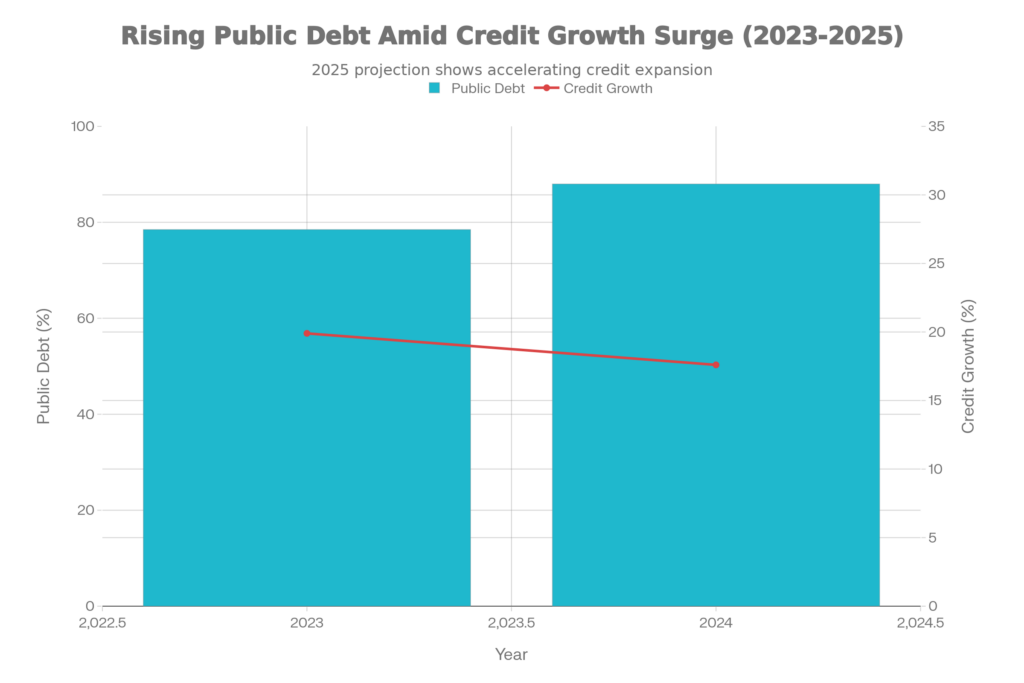
Interest rates are punitive, and much of the reported credit growth reflects refinancing of distressed loans rather than new investment in factories, farms, or value chains.
The disconnect was evident when Mwale announced a second Economic Growth Symposium scheduled for early 2026.
The inaugural event was hailed as a success in “aligning stakeholders.”
For the estimated 40,000 artisanal miners scattered across Malawi’s rural hinterlands, such gatherings are distant echoes.
Operating largely outside the formal financial system, they remain excluded from the “linkages” policymakers celebrate.
As the RBM accelerates its push toward a cashless economy in the name of transparency, artisanal mining remains cash-based not by choice, but by exclusion.
The new regulations, with steep penalties and digital compliance requirements, risk pushing this vibrant informal economy further underground rather than integrating it.
Malawi stands at an inflection point. The Foreign Exchange Act is a bold attempt to impose order on a chaotic market.
But if investigation and sanctioning stop at the doors of commercial banks, while multi-billion-dollar data gaps in the extractive industries remain unaddressed, the 2026 symposium may amount to little more than a post-mortem of yet another stalled recovery.
True economic patriotism requires more than mobilising diaspora remittances.
It demands the political will to audit, reconcile, and confront powerful interests that have turned Malawi’s natural wealth into a statistical error.
Until then, the “sustainable path” remains carefully mapped, and consistently avoided.
