
Malawi votes on Tuesday under shadows of mistrust, hunger, and political déjà vu.
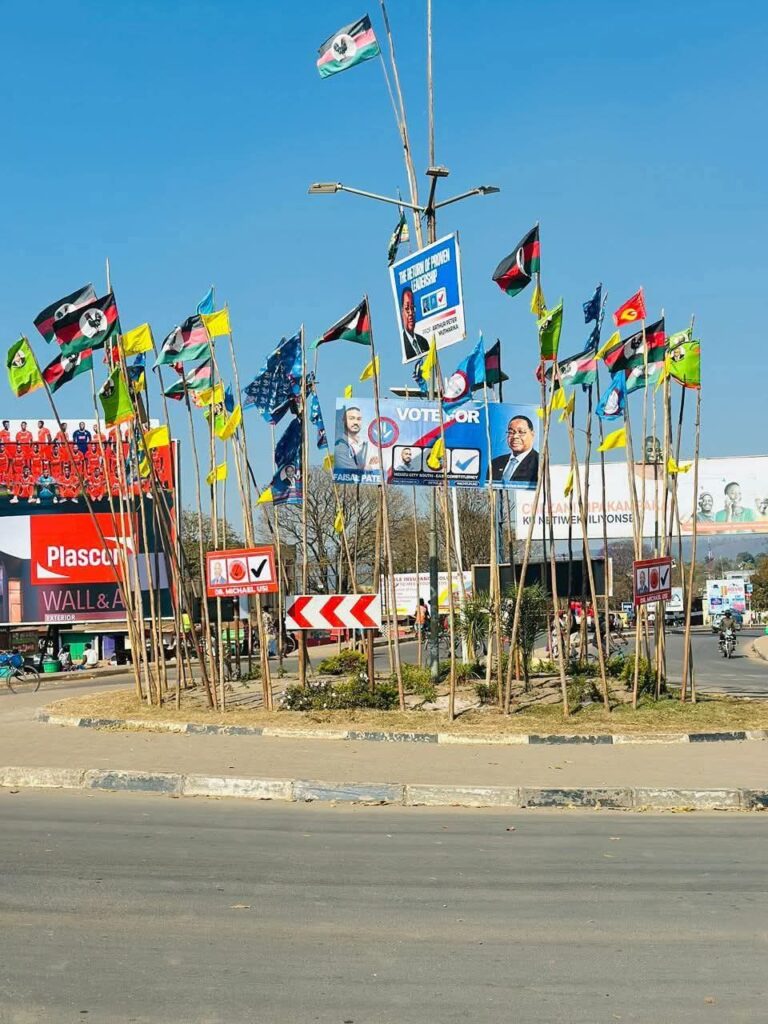
More than seven million people are expected at the polls in a general election that could decide whether the country’s fragile democracy is strengthened or frays further.
This is the first presidential contest since Malawi’s Constitutional Court annulled the disputed 2019 results, an unprecedented moment once hailed across Africa as proof that institutions could stand against power. Five years on, that legacy faces its hardest test.
The Malawi Electoral Commission (MEC) insists it is ready, with ballots distributed nationwide.
By law, it must declare official results within eight days of polling, in line with the Elections Act and a recent High Court ruling that also requires results to be based only on physical returns from polling centres.
“The Commission wishes to reaffirm its unwavering commitment to managing these elections with integrity, professionalism, and transparency. We appeal to all … to embrace peace, patience, and responsibility. Elections must be about ideas and choices, not violence or division,” said MEC Chairperson Justice Annabel Mtalimanja on Saturday during the official closing of the campaign period.
Voters will be electing the President, 229 Members of Parliament, and 509 local councillors, one of the most extensive ballots since the return of multiparty democracy in 1994.
Yet confidence is scarce.
A trial run of its electronic results system in August exposed glitches, reviving memories of 2019 when tally sheets were doctored with correction fluid. The opposition seized on the missteps.
The Democratic Progressive Party (DPP), United Transformation Movement (UTM), and Alliance for Democracy (AFORD) accuse MEC of blocking transparency, especially over its partnership with Smartmatic International Holding B.V., a technology firm linked to election controversies in Venezuela, the Philippines, and Kenya.
In July, the coalition went to court, demanding an independent audit of MEC’s systems. On Friday last week, High Court judge Chimbizgani Kacheche dismissed their plea, ruling MEC acted within its mandate.
But the judge also ordered that no electronic results be announced until a manual tabulation is complete.
In a moment thick with symbolism, Kacheche had to deliver his decision orally after his laptop malfunctioned, locking him out of his written judgement.
Opposition leaders remain unsatisfied. “Without an audit, how do we know Smartmatic’s system cannot be tampered with?” asked DPP Secretary General Peter Mukhito, noting the company’s devices were already used for voter registration.
The campaign trail has been scarred by violence. In November 2024, masked men armed with machetes attacked protesters in Lilongwe. Clashes at opposition rallies left DPP supporters injured. Civil society groups warn that unchecked impunity is feeding tension.
The field of candidates is crowded with familiar names. President Lazarus Chakwera, 70, seeks a second term but faces an 85-year-old rival in his predecessor Peter Mutharika, ousted in 2020.
Former president Joyce Banda has also entered the race, ensuring three of Malawi’s six past leaders will be on the ballot.
The death of Vice President Saulos Chilima in a plane crash last year fractured the ruling Tonse Alliance. His UTM party has regrouped under Dalitso Kabambe, a former central bank governor.
Meanwhile, Chilima’s successor, Vice President Michael Usi, is running under his own banner, an unprecedented challenge to an incumbent from within government.
Polls suggest Mutharika holds a narrow lead, but with Malawi’s constitution requiring a 50%+1 majority, a runoff looms likely.
Young voters, the largest bloc, express little enthusiasm. Political analyst Wonderful Mkhutche puts it bluntly: “Yes, survival is the main issue in this election. Sadly, none of the leading candidates are a saviour.”
Survival is no exaggeration. The World Bank forecasts growth of just 2 percent this year, below the 2.6 percent population increase, Malawians are getting poorer by the day.
Inflation above 30 percent and an El Niño-driven drought have deepened hunger. More than 15.8 million citizens, 71 percent of the population, live on less than $2.15 a day.
“It’s the same old faces with the same tired promises,” said Mathews Saka, a shopkeeper in Lilongwe.
Observer missions from the African Union, COMESA, the EU, and SADC are on the ground. On September 8, the Public Affairs Committee, Malawi’s interfaith watchdog, convened a peace pledge. Most candidates signed; Mutharika’s absence was conspicuous.
“The 2025 election is more than a test of procedures,” the Institute for Security Studies warned. “It is a test of whether reforms can rebuild trust.”
